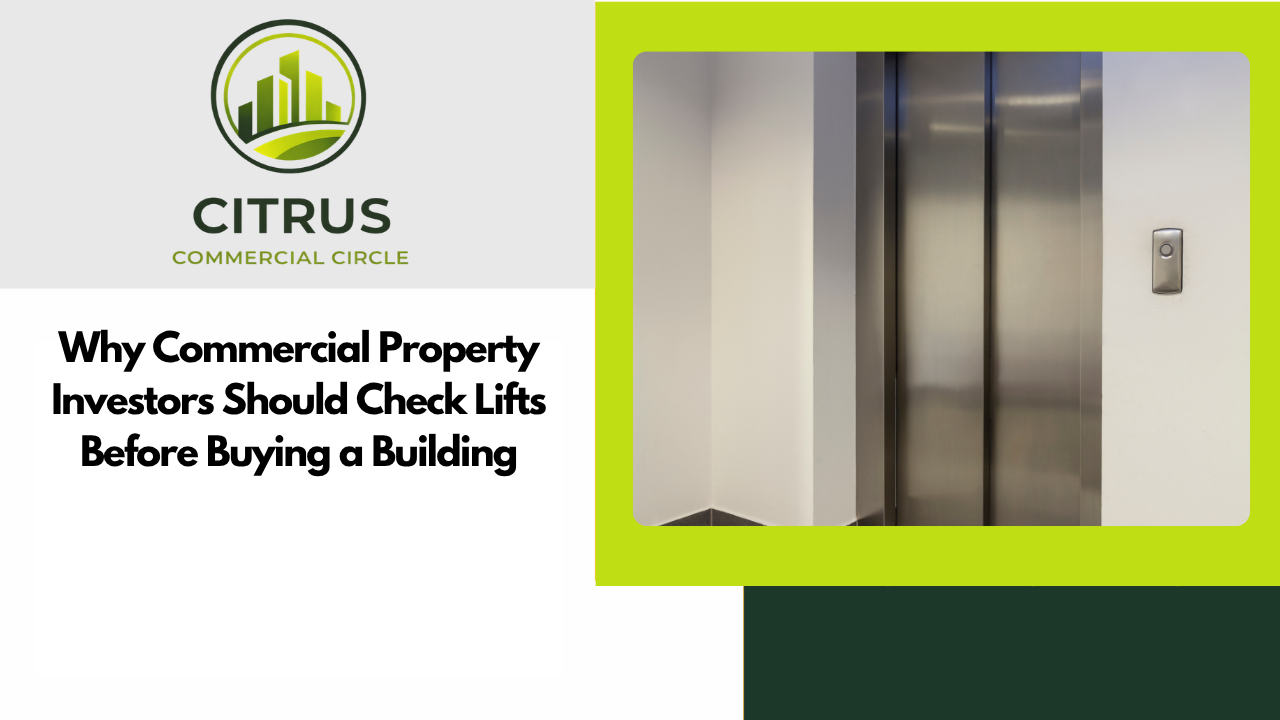
Why Commercial Property Investors Should Check Lifts Before Buying a Building
Commercial property investors spend considerable time examining roofs, leases, rents and tenant covenants.
But in a multi-storey building, another piece of infrastructure can have a surprisingly large influence on value:
The lift.
A lift can make upper floors commercially viable.
It can improve accessibility.
A goods lift can allow businesses to move stock between floors.
But lifts can also create significant:
- Maintenance
- Compliance
- Replacement
costs.
A lift that appears perfectly functional during a ten-minute property viewing may be ageing, poorly documented or approaching major expenditure.
For investors considering offices, mills, mixed-use buildings, industrial premises and other multi-storey commercial property, lift due diligence deserves more attention than simply pressing the button and seeing whether the doors open.
Why lifts matter commercially
Consider a four-storey office building.
Without reliable lift access, the upper floors may become substantially less attractive.
Now consider a multi-storey industrial building.
If businesses depend on a goods lift to move stock, a prolonged breakdown can materially affect their operation.
The lift is therefore not merely a convenience.
It can be part of the building’s commercial functionality.
Start by identifying every lifting installation
Depending on the property, this might include:
- Passenger lifts
- Goods lifts
- Platform lifts
- Service lifts
- Vehicle lifts
Different equipment can have different inspection, maintenance and operational requirements.
Investors should establish exactly what exists.
Do not assume all lifting equipment is the same
A passenger lift in an office performs a very different function from a goods lift serving a warehouse.
Likewise, a platform lift installed for accessibility may have different characteristics.
The due-diligence approach should reflect the actual equipment.
Find out how old the lift is
Age does not automatically mean poor condition.
A well-maintained older lift may continue to perform reliably.
But investors should understand:
- Installation date
- Major modernisation history
- Key component replacement
A lift that has operated for decades without substantial modernisation may require future capital expenditure.
Ask when it was last modernised
A lift may have been installed forty years ago but substantially upgraded ten years ago.
That is very different from a system still relying on much of its original equipment.
The headline installation date therefore does not tell the whole story.
Obtain the maintenance history
Investors should request available documentation showing:
- Routine servicing
- Call-outs
- Repairs
- Recurring faults
- Modernisation works
This can reveal whether the lift has been reliable.
Repeated breakdowns deserve attention
A service history containing constant call-outs may indicate:
- Ageing components
- Control problems
- Door faults
It does not necessarily mean immediate replacement is required.
But the investor should understand the likely cause and future cost.
Ask who maintains the lift
Identify:
- Maintenance contractor
- Contract type
- Annual cost
- Notice provisions
The existing arrangement may or may not transfer to the purchaser.
Maintenance contracts can vary significantly
One agreement might cover routine servicing only.
Another may include certain replacement components.
Investors should understand what is actually included before using the annual maintenance figure in their financial model.
A low maintenance contract can hide repair costs
Suppose the seller says:
“The lift only costs £2,000 per year to maintain.”
That sounds attractive.
But if every breakdown generates a separate invoice, the true annual cost could be much higher.
Review historic expenditure where available.
Planned maintenance and reactive repairs are different
Good asset management should not rely entirely on waiting for equipment to fail.
A specialist may identify components approaching the end of their useful life.
This allows expenditure to be planned.
Understand LOLER
The Lifting Operations and Lifting Equipment Regulations 1998 – commonly known as LOLER – apply to lifting equipment used at work in relevant circumstances.
Depending on the equipment and use, statutory thorough examinations may be required.
Investors should obtain appropriate specialist advice for the particular property.
The Health and Safety Executive’s LOLER guidance provides official information.
Maintenance and thorough examination are not the same thing
This is an important distinction.
A routine service helps maintain the equipment.
A statutory thorough examination has a different purpose.
Investors should not assume a maintenance invoice proves all examination obligations have been satisfied.
Ask for examination reports
Where applicable, obtain available:
- Thorough examination reports
- Defect reports
- Follow-up evidence
Outstanding defects should be investigated.
Defects can have different levels of urgency
A report may identify an issue requiring:
- Immediate action
- Repair within a period
- Monitoring
The investor needs to understand the significance rather than simply noting that a defect exists.
Use competent specialists
Commercial lift systems are specialist equipment.
A building surveyor may identify broad concerns.
But detailed condition assessment may require a lift consultant or suitably competent engineer.
For a large building, specialist advice can be money well spent.
Passenger lifts influence office lettability
Imagine marketing fourth-floor offices.
The accommodation is:
- Bright
- Refurbished
- Well located
But the lift is unreliable.
That can materially weaken demand.
Businesses do not want employees or visitors regularly climbing several flights of stairs because equipment is out of service.
Reliability can influence tenant retention
A tenant may tolerate one breakdown.
Repeated failures create frustration.
For occupiers with:
- Customers
- Older visitors
- Mobility requirements
the problem can become particularly serious.
Accessibility deserves careful consideration
Lifts can form an important part of how people access different levels of a commercial building.
Investors should consider accessibility as part of wider building due diligence and obtain appropriate professional advice.
The building’s overall access strategy matters, not simply whether a lift exists.
A lift may not serve every floor
Do not assume it does.
Check:
- Which floors are served
- Where entrances are located
- Whether access is practical
A lift that stops half a level away from certain accommodation may provide less benefit than expected.
Lift size matters
A small passenger lift may be perfectly adequate for normal office use.
But an occupier regularly moving:
- Equipment
- Large deliveries
may need something larger.
The specification should match the likely tenant market.
Goods lifts can transform multi-storey industrial buildings
Older mills and warehouses sometimes contain substantial upper-floor accommodation.
Without a goods lift, moving stock can be difficult.
A functioning goods lift can therefore unlock the commercial usefulness of those floors.
Goods-lift capacity should be verified
Useful information includes:
- Rated load
- Platform dimensions
- Door dimensions
- Floors served
Do not simply advertise:
“Goods lift.”
The specification matters.
A small lift may not suit palletised goods
An occupier may need to move:
- Pallets
- Machinery
- Trolleys
If the lift cannot accommodate them, its practical value is reduced.
Loading route matters too
Imagine a large goods lift.
Excellent.
But the route from the loading bay to the lift contains:
- Narrow doorways
- Steps
- Tight corners
The building may still be difficult operationally.
Investors should follow the entire goods route.
Check the lift against likely occupational use
For a multi-storey storage property, ask:
Can tenants actually move goods efficiently from vehicle to upper floor?
This practical exercise can reveal limitations that specifications alone miss.
Lift failure can make upper floors temporarily unusable
This creates operational risk.
If the building’s rental income depends heavily on upper floors, lift reliability becomes financially important.
Investors should consider the consequence of prolonged downtime.
What happens if a specialist component fails?
Older lifts may use components that are:
- Obsolete
- Difficult to source
- Expensive
This can extend repair times.
A specialist condition report can help identify obsolescence risk.
Replacement can be expensive
Complete lift replacement or substantial modernisation can represent significant capital expenditure.
The cost depends on:
- Lift type
- Building
- Specification
- Shaft
Investors should obtain property-specific estimates rather than relying on generic figures.
Include lift expenditure in the acquisition model
Suppose an office investment produces attractive income.
But the lift consultant advises that major modernisation is likely within three years.
That expenditure should be included in the investment appraisal.
Otherwise, the headline return may overstate performance.
Capital expenditure affects yield differently from annual maintenance
A £3,000 annual service contract is easy to model.
A substantial modernisation project every few decades is less visible.
Both matter.
Sellers should expect sophisticated buyers to ask
When preparing a commercial property for sale, vendors should organise:
- Maintenance contracts
- Inspection reports
- Repair invoices
- Modernisation records
Good documentation can reduce buyer uncertainty.
Missing records can affect negotiations
A buyer confronted with:
- Unknown lift age
- No inspection records
- No service history
may assume a more conservative capital allowance.
Poor documentation can therefore have a financial consequence.
Multi-let buildings need clear responsibility
Who pays for lift maintenance?
In many multi-let commercial properties, the landlord maintains shared lifts and may recover costs through service charge, subject to the leases.
But the precise wording matters.
Check every lease
Do not assume because one tenant contributes to lift costs that all tenants do.
Different leases may contain:
- Different service-charge provisions
- Caps
- Exclusions
This is particularly important in older multi-let investments where leases were granted at different times.
Ground-floor tenants may challenge lift costs
A ground-floor occupier might argue that it receives little benefit from a passenger lift.
Whether it is contractually required to contribute depends on the lease.
Investors should understand the actual service-charge structure before purchase.
Service-charge caps can create landlord exposure
Suppose major lift expenditure is required.
If tenant contributions are capped, the landlord may need to fund the balance.
This can reduce net income materially.
Major works recovery requires legal review
Do not assume every replacement or modernisation cost can automatically be passed through the service charge.
Lease wording should be reviewed by the purchaser’s solicitor.
Void units can increase the owner’s contribution
In a partially vacant building, the landlord may bear the service-charge contribution attributable to empty accommodation.
A major lift project during a high-vacancy period can therefore be particularly expensive.
Sinking funds may help
Some properties collect reserve or sinking-fund contributions for future major expenditure.
If a fund exists, investors should establish:
- Current balance
- Permitted use
- Accounting treatment
A large balance may help fund future works.
A depleted fund may indicate approaching liabilities.
Check whether major works have already been planned
Meeting minutes, managing-agent correspondence or contractor reports may reveal proposed:
- Modernisation
- Replacement
- Repairs
This information can be extremely important during acquisition.
Lift expenditure can influence rent
A building with a modern reliable passenger lift may support stronger upper-floor office demand than an otherwise similar walk-up property.
Infrastructure therefore affects income as well as cost.
Upper floors can become substantially more valuable
Imagine a three-storey building where upper floors are currently difficult to access.
Improved lift provision could potentially broaden the occupier market.
In some value-add strategies, vertical access can unlock underused space.
But installing a new lift is not always straightforward
A building without a lift may require:
- Structural alterations
- New shaft
- Electrical works
- Planning or Building Regulations considerations
The economics need careful assessment.
Historic buildings can create additional complexity
Listed buildings or properties within conservation areas may require greater design sensitivity.
A lift installation could affect:
- Historic fabric
- Internal layout
- External appearance
Specialist heritage and planning advice may be required.
Mills frequently make lift due diligence important
North Manchester and the wider North West contain many historic multi-storey industrial buildings.
Their upper floors can offer:
- Workshops
- Storage
- Studios
But accessibility and goods movement can determine whether those floors are commercially useful.
An old goods lift can be an asset and a liability
It may provide valuable access.
But it may also be:
- Ageing
- Slow
- Difficult to maintain
Investors should establish whether preserving it is economically sensible.
Lift speed can matter
In a busy office, an extremely slow lift can frustrate occupiers.
In a warehouse where it moves goods only occasionally, speed may matter less.
Again, assess equipment in the context of use.
Capacity can affect office buildings too
A tall office building with many employees may require sufficient lift capacity to handle peak movement.
A small lift serving a heavily occupied building can create queues.
This can affect tenant experience.
Development schemes should model occupancy
If an investor plans to convert low-density space into a heavily occupied use, existing lift provision may no longer be sufficient.
Examples might include:
- Office intensification
- Leisure use
- Education
Specialist design advice should be obtained.
Change of use can change lift requirements
A building previously used for storage may have very different occupancy from one converted into offices.
Vertical circulation needs to be reconsidered as part of the overall development strategy.
Fire strategy should be reviewed separately
A normal passenger lift should not simply be assumed to function as a fire evacuation solution.
Fire strategy, evacuation arrangements and specialist lift requirements need professional assessment.
Official fire-safety information is available through GOV.UK.
Emergency communication systems should be checked
Passenger lifts may contain emergency communication equipment.
Investors should ensure relevant systems are maintained and suitable for current requirements.
This can become particularly important as older telecommunications infrastructure changes.
Technology upgrades can create hidden requirements
An older lift may rely on communication or control technology approaching obsolescence.
Modernisation may therefore involve more than replacing visible mechanical parts.
Control systems can become obsolete
Electronic lift controls evolve.
When older systems fail, replacement components may be unavailable.
This can turn what appears to be a minor repair into a wider modernisation project.
Doors are a common operational issue
Lift doors experience repeated daily movement.
Problems with:
- Sensors
- Closers
- Tracks
can cause breakdowns even where the main lifting machinery remains functional.
Maintenance records can reveal patterns.
Water ingress can damage lift equipment
Lift pits and plant areas should be inspected for signs of:
- Water
- Damp
- Drainage problems
Water and electrical/mechanical equipment are a poor combination.
The source should be investigated.
Basement lifts need particular attention to drainage
Where lift pits sit below external ground or drainage levels, water ingress risk may be greater.
Investors should ask whether flooding has occurred historically.
Roof plant may serve the lift
Depending on the system, equipment may be located in:
- Plant rooms
- Roof areas
Access for engineers needs to be safe and practical.
Machine-room access can affect maintenance
If contractors struggle to access equipment, maintenance can become more complicated.
Check:
- Access routes
- Security
- Working space
These practical details matter.
Energy consumption should be considered
Lifts form part of building energy use.
Modern systems may offer improved efficiency compared with older equipment.
However, replacement decisions should be based on the overall commercial case rather than energy considerations alone.
Planned modernisation can improve tenant experience
A lift upgrade may provide:
- Better reliability
- Improved controls
- Modern interior finishes
This can contribute to repositioning an office building.
The lift car itself influences perception
For office and customer-facing property, the lift is part of the arrival experience.
A visitor entering a:
- Damaged
- Poorly lit
- Graffiti-covered
lift forms an immediate impression of the building.
Cosmetic refurbishment can be relatively modest compared with mechanical replacement
In some cases, the machinery is sound but the lift interior looks dated.
Updating:
- Lighting
- Finishes
- Controls
may improve presentation.
Any works should be completed by appropriate specialists.
Do not confuse appearance with mechanical condition
A newly refurbished lift car can still contain ageing underlying equipment.
Likewise, an unattractive old lift may be mechanically reliable.
Investors need both visual and technical assessment.
Passenger entrapment procedures matter
Building management should know what happens if someone becomes trapped.
Questions include:
- Who receives the call?
- How quickly can an engineer attend?
- Is emergency communication working?
This is part of responsible building management.
Out-of-hours use changes the risk profile
A building operating 24/7 may require different maintenance and response arrangements from one used only during normal office hours.
The maintenance contract should reflect actual occupation.
Tenant businesses may depend on lift reliability
For some occupiers, a broken lift is inconvenient.
For others, it can seriously disrupt trading.
A storage operator on an upper floor may be unable to move stock efficiently without the goods lift.
This can influence lease negotiations and tenant retention.
Consider business interruption when planning works
Major modernisation may require the lift to be out of service.
Landlords should plan around occupiers and communicate early.
Temporary arrangements may be required.
One lift versus multiple lifts creates different risk
A building with three passenger lifts may retain some functionality when one fails.
A building with a single lift has no redundancy.
That makes reliability more important.
Redundancy can be valuable in larger buildings
Where tenant operations depend heavily on vertical movement, multiple lifts can reduce operational risk.
However, they also create additional maintenance cost.
The investor needs to balance both sides.
Check whether any lifts are permanently out of service
A building may physically contain two lifts but only one is operational.
Why?
Possible reasons include:
- Cost
- Obsolescence
- Previous failure
An unused lift shaft should prompt investigation.
Decommissioned equipment can still create liabilities
If a lift is no longer used, investors should understand:
- Its condition
- Whether it has been properly decommissioned
- Whether removal is planned
Simply locking the doors does not necessarily resolve every issue.
Tenant-installed lifting equipment should be identified
Industrial tenants may install:
- Platform lifts
- Vehicle lifts
- Specialist lifting systems
Ownership and responsibility should be established.
Do not assume equipment belongs to the landlord
The lease or Licence to Alter may show that equipment:
- Belongs to tenant
- Must be removed
- Can remain
This can affect both acquisition value and future dilapidations.
Vehicle lifts deserve particular attention
Certain automotive premises use vehicle lifts as part of their operation.
These may be tenant equipment rather than landlord fixtures.
Investors should distinguish operational machinery from building infrastructure.
The lease should identify responsibilities clearly
Questions include:
- Who maintains it?
- Who insures it?
- Who replaces it?
- Who removes it?
Unclear responsibility can become expensive.
Acquisition surveys should look beyond the building fabric
Traditional property due diligence often concentrates on:
- Roof
- Walls
- Floors
But operational equipment can carry equally significant liabilities.
For complex commercial assets, M&E and specialist equipment surveys can be valuable.
Ask for a five-year expenditure forecast
Where possible, a lift consultant can help identify likely expenditure over the coming years.
This might include:
- Routine maintenance
- Component replacement
- Modernisation
That allows more accurate investment modelling.
Model worst-case scenarios too
Ask:
What if major modernisation is required sooner than expected?
The acquisition should still make financial sense under a reasonable downside scenario.
A high yield can hide an ageing building
Older multi-let property may produce attractive income.
But that income may partly compensate investors for future capital requirements.
Lifts are one example of why headline yield should never be assessed in isolation.
Net income matters
Gross rent:
£200,000.
Looks attractive.
But if the landlord faces substantial unrecoverable expenditure on:
- Lift
- Roof
- Heating
the effective return is different.
Good investors understand the asset behind the income.
Modernisation can create value
Not every lift problem is simply a liability.
An investor may deliberately acquire a tired office building and improve:
- Lift
- Reception
- Common areas
This can reposition the property.
Common-area improvement can change tenant perception
Occupiers experience the building through shared spaces before reaching their own suite.
A modernised lift combined with:
- Better lighting
- Cleaner corridors
- Improved entrance
can transform perception.
This can support office re-letting
A landlord trying to achieve stronger rents on upper-floor accommodation should consider whether the shared infrastructure supports that ambition.
Premium rent and neglected common areas rarely fit comfortably together.
Industrial buildings require a different approach
In a warehouse or mill, aesthetics may matter less.
Reliability and capacity matter more.
A scratched goods lift that works perfectly may be more valuable than a beautiful passenger lift incapable of moving stock.
Match investment to occupational need
This principle runs throughout commercial property.
The best specification is the one that supports the tenant market.
Purchasers should check whether the lift has any outstanding recommendations
Inspection and maintenance reports may contain recommendations that have not yet been actioned.
These should be:
- Identified
- Costed
- Assessed
before acquisition where possible.
Outstanding works can become negotiation points
If substantial expenditure is identified, the purchaser may:
- Adjust its offer
- Request works
- Budget accordingly
Due diligence does not automatically mean abandoning the acquisition.
It means understanding the risk.
Vendor information should be verified
A seller may genuinely believe:
“The lift is fine.”
But that statement is not a technical assessment.
Investors should obtain appropriate evidence.
Never rely solely on a viewing
A lift completing one journey successfully tells you almost nothing about:
- Maintenance history
- Compliance
- Remaining life
Specialist due diligence provides the deeper picture.
Investors should create a lift due-diligence checklist
Before purchasing a building containing lifts, consider asking for:
- Equipment schedule
- Installation dates
- Maintenance contracts
- Service history
- Thorough examination reports
- Modernisation history
- Outstanding defect reports
- Repair expenditure
The exact requirements depend on the property.
Understand who pays
Then overlay the technical information with the leases.
For every significant future cost, ask:
Landlord?
Tenant?
Service charge?
That question converts engineering information into investment information.
Consider vacancy
If upper floors become vacant, can they be re-let easily with the existing lift?
This is particularly important when purchasing an investment with near-term lease expiries.
Future tenants may expect more than existing tenants
An occupier that has been in a building for twenty years may tolerate an ageing lift.
A new tenant comparing refurbished offices may not.
Investors should assess future market expectations, not only current occupation.
Exit value matters
When the investor eventually sells, the next buyer will conduct similar due diligence.
If the lift is then significantly older and no capital plan exists, the issue may affect pricing.
Planning expenditure during ownership can therefore support exit.
Keep documentation organised
After acquisition, maintain a clear property file containing:
- Inspections
- Maintenance
- Repairs
- Modernisation works
This helps both management and eventual sale.
Good records demonstrate active management
An investor buying a building with twenty years of organised lift records gains confidence.
A cardboard box containing three unexplained invoices creates the opposite impression.
Documentation has commercial value.
Planned maintenance reduces surprises
Commercial property will always require expenditure.
The goal is not eliminating cost.
It is reducing unexpected cost.
Lifts are a perfect example.
Citrus Commercial Circle’s market insight
At Citrus Commercial Circle, we believe investors should look at commercial buildings operationally, not simply visually.
A multi-storey property may appear attractive because of:
- Strong rent
- Good location
- Large floor area
But if its upper floors depend on an ageing lift, that equipment forms part of the investment story.
Investors should understand:
What lift is installed?
How old is it?
How reliable is it?
What records exist?
Who pays for future work?
For some properties, the answers may show relatively little risk.
For others, they may identify significant future capital expenditure.
Either outcome is useful.
The purpose of due diligence is not to find reasons not to buy.
It is to know what you are buying.
Final thoughts
Commercial lifts are easy to overlook during property acquisition.
They should not be.
A lift can influence:
- Accessibility
- Upper-floor rents
- Tenant retention
- Building functionality
- Service charges
- Capital expenditure
Investors considering commercial buildings with passenger or goods lifts should investigate both the technical equipment and the lease responsibilities surrounding it.
Do not stop at:
“The lift works.”
Ask:
“How long is it likely to keep working, what will it cost, and who is responsible when it doesn’t?”
That is the question that matters to an investor.
At Citrus Commercial Circle, we help commercial property investors across Bury and North Manchester understand the practical factors that influence commercial property performance, risk and long-term value.
Based in Bury. Active across North Manchester. Always on your side.
Call us today: 0161 383 1806
Email: info@citruscommercialcircle.co.uk
Visit: citruscommercialcircle.co.uk
Let’s unlock the full potential together.
Citrus Commercial Circle – Where standards meet success.