

How Infrastructure Projects Are Shaping Property Demand Across Greater Manchester
The link between connectivity and commercial success
Infrastructure has always played a central role in shaping property markets. Roads, railways, public transport, and regeneration schemes do more than improve connectivity — they directly influence where businesses choose to locate, where investors deploy capital, and where long-term growth occurs.
Across Greater Manchester, ongoing and planned infrastructure projects are continuing to transform the commercial property landscape. From improved motorway access to expanding Metrolink routes and town-centre regeneration, these developments are creating new opportunities for landlords, occupiers, and investors alike.
At Citrus Commercial Circle, we monitor these changes closely, helping clients understand how infrastructure impacts demand and where future opportunities are likely to emerge.
1. Transport links drive occupier demand
Accessibility is one of the most important factors for any commercial property. Businesses require premises that are easy to reach for employees, customers, and suppliers.
Strong transport infrastructure provides:
- Faster commuting times for staff
- Efficient logistics and delivery routes
- Greater catchment areas for customers
- Improved operational efficiency
Areas with direct access to major routes such as the M60, M62, and M66 consistently attract strong demand, particularly for industrial and logistics properties.
2. The continued expansion of Metrolink
Greater Manchester’s Metrolink network has been one of the most significant infrastructure investments in the region. Its expansion has had a noticeable impact on property demand in areas such as Bury, Rochdale, and Oldham.
Properties located near Metrolink stops benefit from:
- Increased footfall for retail and service businesses
- Easier commuting for office occupiers
- Greater appeal for residential and mixed-use developments
For landlords, proximity to a tram stop can significantly enhance both rental demand and long-term asset value.
3. Road infrastructure and logistics growth
The North West’s strong road network continues to underpin its industrial and logistics market. Improvements to key routes and junctions allow businesses to operate more efficiently and serve wider regions.
Locations close to:
- The M60 orbital motorway
- The M62 trans-Pennine route
- The M66 corridor linking to Bury and Rossendale
are particularly attractive for:
- Distribution and logistics operators
- Trade counters and construction firms
- E-commerce fulfilment businesses
This has driven sustained demand for small and mid-sized industrial units across Greater Manchester and surrounding towns.
4. Regeneration schemes and town-centre investment
Infrastructure is not limited to transport. Regeneration projects, public realm improvements, and investment in local amenities are equally important.
Town-centre regeneration often includes:
- Improved pedestrian access and public spaces
- Upgraded retail and leisure environments
- Residential development within central areas
- Enhanced lighting, safety, and accessibility
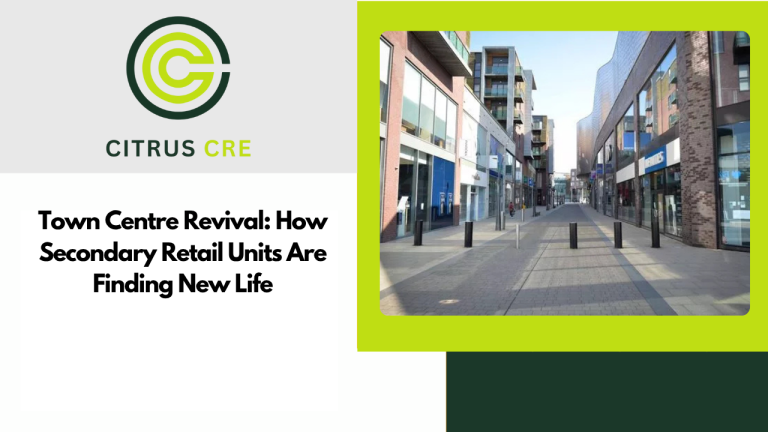
These improvements make town centres more attractive for both businesses and consumers, increasing demand for retail, office, and mixed-use premises.
At Citrus Commercial Circle, we have seen how regeneration in towns such as Bury has contributed to renewed interest in commercial space.
5. The impact on property values
Infrastructure improvements often lead to measurable increases in property value. As areas become more accessible and attractive, demand rises, and this is reflected in both rental levels and capital values.
Key impacts include:
- Higher rental demand from occupiers
- Reduced vacancy rates
- Increased investor interest
- Long-term capital appreciation
Properties located in areas undergoing infrastructure investment often outperform those in less connected locations.
6. Unlocking secondary markets
One of the most important effects of infrastructure investment is the unlocking of secondary locations. Areas that were previously considered less accessible or less desirable can become highly attractive once connectivity improves.
This is particularly evident in:
- Bury and surrounding areas
- Middleton and Chadderton
- Rochdale and Oldham
As transport links improve, these locations offer a compelling combination of affordability and accessibility, attracting both occupiers and investors.
7. Supporting business growth
Infrastructure does not just benefit property values; it supports business growth more broadly.
Improved connectivity allows businesses to:
- Recruit from a wider labour pool
- Serve larger customer bases
- Reduce travel and logistics costs
- Operate more efficiently
This, in turn, strengthens local economies and reinforces demand for commercial premises.
8. Opportunities for development land
Infrastructure investment often creates new opportunities for development. Land that was previously underutilised can become viable for residential, commercial, or mixed-use schemes.
Developers typically look for sites that benefit from:
- Planned or recently completed transport improvements
- Proximity to regeneration zones
- Access to utilities and services
- Strong local demand for housing or employment space
At Citrus Commercial Circle, we regularly advise clients on development opportunities that arise from these changing dynamics.
9. Long-term investment strategy
For investors, understanding infrastructure trends is essential for making informed decisions.
Key considerations include:
- Identifying areas with planned improvements
- Assessing long-term demand drivers
- Evaluating potential for rental growth
- Considering future resale value
Investing ahead of infrastructure completion can offer significant upside, but it requires careful analysis and professional guidance.
10. Citrus Commercial Circle’s local insight
Our team combines local knowledge with market expertise to help clients navigate these changes. We provide:
- Insight into emerging locations and demand patterns
- Advice on property positioning and investment strategy
- Support with acquisitions, lettings, and disposals
- Clear, professional guidance tailored to each client
Being based in Bury and active across North Manchester gives us a direct understanding of how infrastructure is shaping real-time demand.
Final thoughts
Infrastructure is one of the most powerful forces shaping the commercial property market. From transport links to regeneration schemes, these developments influence where businesses locate, where investors focus, and where future growth will occur.
For landlords and investors, recognising these trends early provides a significant advantage. By aligning property strategy with infrastructure development, it is possible to unlock long-term value and secure stronger performance.
At Citrus Commercial Circle, we are proud to help clients across the North West make informed, strategic decisions based on local knowledge and professional expertise.
Based in Bury. Active across North Manchester. Always on your side.
Call us today: 0161 383 1806
Email: info@citruscommercialcircle.co.uk
Visit: citruscommercialcircle.co.uk
Let’s unlock the full potential together.
Citrus Commercial Circle – Where standards meet success.