
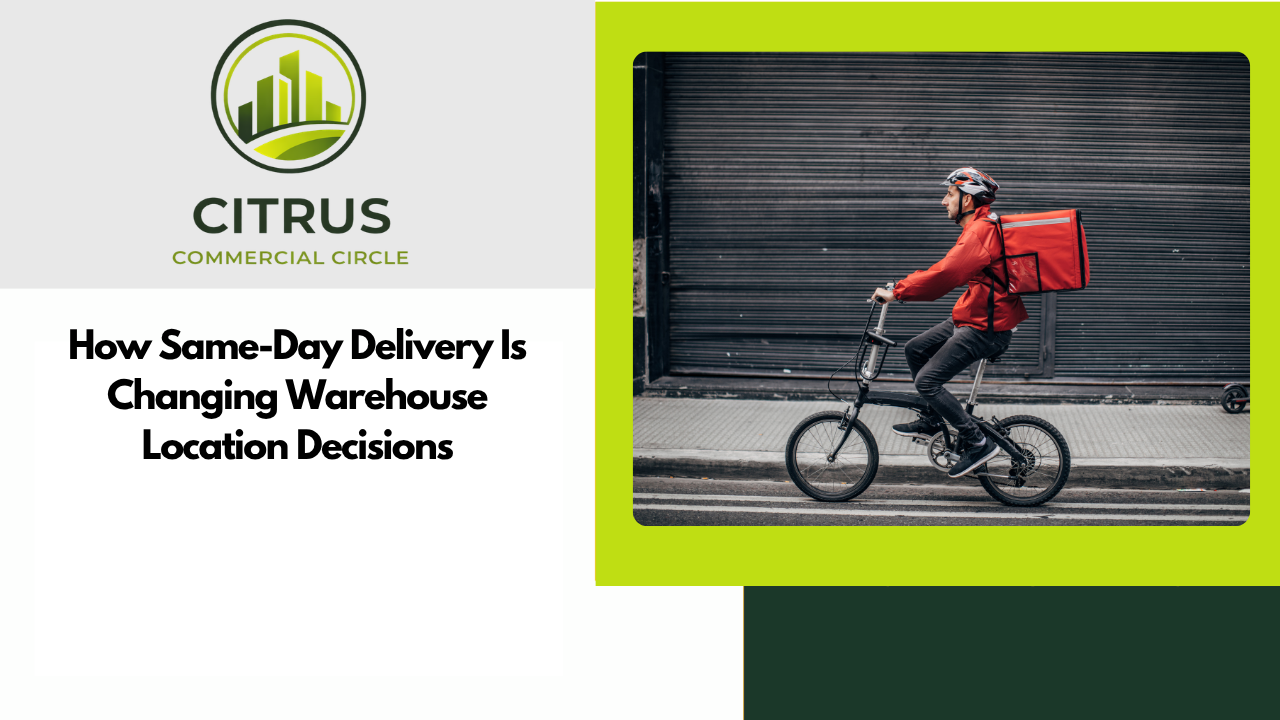
How Same-Day Delivery Is Changing Warehouse Location Decisions
For decades, warehouse property decisions were heavily influenced by a relatively simple objective:
Find enough space at the right rent with good motorway access.
Those fundamentals still matter.
But modern delivery expectations are adding another layer.
Customers increasingly expect businesses to process orders quickly, provide accurate delivery information and, in some markets, offer next-day or even same-day delivery.
That changes the role of the warehouse.
It is no longer simply somewhere to store products.
For many businesses, it is becoming an active part of the customer-service operation.
And that means warehouse location can have a direct impact on how quickly a business can fulfil orders.
For industrial occupiers, landlords and investors across Bury, North Manchester and Greater Manchester, understanding this shift can help explain why two apparently similar warehouses may perform very differently.
The Warehouse Is Moving Closer to the Customer
Traditional distribution models often relied on large regional warehouses.
Products could be stored centrally and transported over relatively long distances.
That model still works for many businesses.
But faster delivery expectations can make proximity increasingly valuable.
Every Mile Can Affect Delivery Time
If a warehouse is located far from the main customer base, vehicles spend more time travelling before making their first delivery.
That can mean:
- More fuel
- More driver time
- Fewer deliveries per vehicle
A slightly more expensive warehouse in a stronger location may therefore reduce wider operating costs.
Property Cost Is Only One Part of the Equation
Businesses sometimes compare warehouses by asking:
“Which has the cheapest rent per square foot?”
A better question may be:
“Which property gives us the lowest overall cost of serving our customers?”
That calculation can produce a very different answer.
Same-Day Delivery Makes Geography More Important
When a customer expects delivery several days later, an extra hour in the supply chain may not matter greatly.
When the promise is:
“Order this morning and receive it today,”
that hour becomes much more important.
This Creates Demand for Well-Connected Urban Warehousing
Warehouses close to substantial population centres can potentially shorten the final part of the delivery journey.
Greater Manchester therefore offers an interesting geography.
Businesses can access a large urban customer base while using commercial locations outside the most expensive central areas.
North Manchester Has a Strategic Position
Locations around:
- Bury
- Rochdale
- Oldham
- Salford
can provide access to large parts of Greater Manchester and the wider North West.
The exact suitability depends on the business, but this combination of population and transport connectivity can be commercially attractive.
Motorways Still Matter
The motorway network remains important.
Connections involving the:
- M60
- M62
- M66
- M61
can help businesses move goods across the region and beyond.
But motorway proximity alone is not enough.
The Last Few Miles Can Determine Performance
A warehouse may sit two miles from a motorway junction.
That sounds excellent.
But if those two miles involve:
- Congested roads
- Difficult junctions
- Restricted access
the operational advantage can disappear.
Test Routes at Realistic Times
Businesses considering warehouse premises should drive important routes during:
- Morning peak
- Afternoon
- Evening peak
Do not rely entirely on estimated journey times from a quiet Sunday.
Map Your Customers Before Choosing a Warehouse
One of the most useful exercises is surprisingly simple.
Plot where your customers actually are.
You may discover that 70% of deliveries go to:
- Manchester
- Salford
- Bury
while only a small proportion travel nationally.
That should influence property strategy.
Analyse Orders Rather Than Assumptions
Use actual sales data where available.
Look at:
- Customer postcode
- Order frequency
- Delivery size
This can reveal the geographical centre of demand.
Suppliers Matter Too
Warehouse location should not be based solely on outbound deliveries.
Goods also need to arrive.
A location may be excellent for customers but inefficient for:
- Suppliers
- Containers
- Manufacturing inputs
The strongest property often balances both flows.
Think in Two Directions
Ask:
How easily can goods reach us?
and:
How easily can goods leave us?
Both affect warehouse performance.
Courier Networks Influence Location Decisions
Many e-commerce businesses rely on parcel carriers rather than their own vehicles.
Companies such as Royal Mail and DPD operate extensive delivery networks.
The location and timing of collections can influence fulfilment operations.
Collection Cut-Off Times Matter
Suppose one warehouse allows a business to hand orders to its carrier later in the day.
That can extend the company’s customer ordering window.
A property decision can therefore indirectly influence sales.
Ask Couriers Before Moving
Before signing a lease, businesses can discuss:
- Collection arrangements
- Cut-off times
- Vehicle requirements
with their logistics providers.
This provides operational information before committing to the property.
Same-Day Delivery Is Not Only an E-Commerce Issue
The principle also affects B2B businesses.
Imagine a contractor urgently needs:
- Electrical equipment
- Tools
- Components
A local supplier able to deliver that afternoon can have an advantage.
Trade Businesses Benefit From Proximity
This helps explain why accessible trade locations remain important.
Businesses such as Screwfix, Toolstation and CEF operate around the principle of making products readily available to customers.
Independent distributors can apply similar thinking.
Warehouse Location Can Become a Competitive Advantage
Imagine two suppliers sell almost identical products.
Supplier A delivers in:
Three days.
Supplier B can reliably deliver:
The same afternoon.
For urgent purchases, speed can influence the customer’s decision.
But Speed Must Be Reliable
Promising same-day delivery and repeatedly failing can damage trust.
The property and logistics system need to support the promise.
Yard Design Matters More as Delivery Frequency Increases
A warehouse processing occasional deliveries may cope with a modest yard.
A high-volume fulfilment operation is different.
Vehicles may constantly be:
- Arriving
- Loading
- Leaving
External space becomes part of the production line.
Avoid Vehicle Conflict
Poorly designed yards can create situations where:
- Incoming deliveries block outgoing vans
- Staff cars occupy loading areas
- Vehicles cannot turn
This reduces efficiency.
Separate Parking From Loading Where Possible
Clearly defined areas can help the site operate more smoothly.
This is particularly useful where delivery volumes are high.
Roller-Shutter Position Matters
A warehouse may have excellent floor area but an inconvenient loading door.
Ask:
- Can vans reverse safely?
- Can larger vehicles access it?
- Is the approach obstructed?
Small physical details can affect hundreds of daily movements.
Door Dimensions Need Checking
Do not assume a loading door will accommodate:
- Pallets
- Equipment
- Vehicles
Measure it.
Internal Layout Affects Dispatch Speed
Fast delivery begins inside the warehouse.
Products need to move efficiently through:
Storage → picking → packing → dispatch.
A badly configured building can slow every order.
Long Internal Journeys Add Up
If employees repeatedly walk from one end of a poorly designed warehouse to another, those minutes accumulate.
At high order volumes, layout becomes important.
Dispatch Areas Need Enough Space
Orders waiting for collection should not obstruct:
- Picking
- Goods-in
- Staff routes
Dedicated dispatch space can improve organisation.
Returns Need Their Own Process
Fast-moving e-commerce businesses can generate significant returns.
If returned goods are placed randomly around the warehouse, inventory accuracy can suffer.
A defined returns area can help.
Eaves Height Can Support Storage Density
A warehouse with greater usable height may allow more efficient racking.
This can increase inventory capacity without increasing the footprint.
But racking design and installation require appropriate professional consideration.
Floor Area Alone Is Not Enough
Two 10,000 sq ft warehouses can have very different capacities because of:
- Height
- Columns
- Layout
Businesses should assess usable operational capacity.
More Stock Can Support Faster Delivery
Same-day fulfilment depends partly on having the right products available locally.
Businesses may therefore hold more inventory closer to customers.
This can increase demand for strategically located storage.
But Inventory Needs Data
Holding every possible product everywhere is expensive.
Modern stock-management systems can help businesses decide which products should be positioned closer to demand.
Technology and Property Work Together
Software may determine:
Which item should be stored where?
But the physical building still needs to allow staff or automated systems to retrieve it efficiently.
Automation Can Change Warehouse Requirements
Some fulfilment operations use:
- Conveyors
- Automated picking
- Robotics
This can increase requirements around:
- Power
- Floor quality
- Layout
Not every warehouse is equally suitable.
Electricity Is Becoming More Important
A modern logistics operation may need power for:
- Automation
- IT
- Charging equipment
Businesses should investigate actual electrical capacity rather than relying solely on the phrase:
“Three-phase available.”
Broadband Is Operational Infrastructure
Warehouse management systems increasingly rely on:
- Cloud software
- Real-time inventory
- Shipping systems
Poor connectivity can disrupt the operation.
Check Connectivity Before Signing
Do not wait until moving day to discover that suitable service will take months to install.
Staff Location Still Matters
Fast fulfilment requires people.
Warehouse location should therefore consider the labour market.
Can staff reach the site?
Public Transport Can Influence Recruitment
Industrial estates are sometimes difficult to access without a car.
Transport for Greater Manchester provides information about public transport across the region.
Transport for Greater Manchester
Businesses employing substantial teams should consider this alongside motorway connectivity.
Shift Patterns Change the Question
A bus route that works at 9 AM may not help staff starting at:
5 AM.
Analyse transport at actual shift times.
Parking Requirements Can Increase With Employment Density
A highly productive fulfilment warehouse may employ more people per square foot than traditional bulk storage.
That can increase demand for staff parking.
Do Not Sacrifice the Entire Yard to Parking
Again, balance matters.
A warehouse needs both:
- People
- Vehicle operations
The external layout needs to accommodate them.
Security Is Critical for High-Value Inventory
Warehouses supporting rapid delivery may hold significant stock.
Businesses may therefore prioritise:
- CCTV
- Controlled access
- Fencing
- Alarm systems
when choosing premises.
Delivery Drivers Also Need Safe Access
Security arrangements should protect the property without making legitimate collections unnecessarily difficult.
Twenty-Four-Hour Access Can Be Valuable
Some logistics operations work outside conventional office hours.
A property restricted to daytime access may not support that model.
Check Lease and Estate Rules
Do not assume that because the building physically has a gate, the tenant can operate at any hour.
Confirm:
- Access rights
- Estate restrictions
before committing.
Planning and Use Need Checking
The intended operation should be compatible with the property’s planning position and lease.
The Planning Portal provides general planning guidance.
Site-specific advice may be needed.
Noise Can Become Relevant
Late-night:
- Van movements
- Loading
- Deliveries
may create issues near residential areas.
This needs consideration when selecting the location.
Urban Warehousing Has a Trade-Off
Being closer to customers can reduce delivery distances.
But urban locations may have:
- Higher rents
- Smaller yards
- More neighbours
Businesses need to calculate whether the location benefit outweighs those constraints.
Edge-of-Urban Locations Can Offer a Compromise
Some North Manchester industrial locations provide relatively quick access to major population centres without requiring a city-centre warehouse.
For many SMEs, that can be attractive.
City-Centre Warehousing Is Not Necessary for Every Fast-Delivery Business
A company does not necessarily need to be in central Manchester to serve Manchester quickly.
What matters is realistic drive time from the property to customers.
Create Delivery Zones
Businesses can map:
- 15-minute radius
- 30-minute radius
- 60-minute radius
from potential warehouses.
This creates a more useful comparison than postcode alone.
Use Real Operational Data
If possible, test routes with:
- Actual delivery addresses
- Actual departure times
Property selection should be evidence-led.
Multiple Warehouses Can Eventually Make Sense
As a business grows, one central warehouse may no longer be the optimal model.
Some companies may consider:
- Main regional hub
- Smaller local facilities
This can shorten final delivery distances.
But Multiple Sites Create Complexity
More locations mean:
- More leases
- More inventory allocation
- More management
The network needs to justify itself.
SMEs Should Avoid Copying Major Logistics Companies Blindly
A multinational retailer may operate dozens of fulfilment sites.
That does not mean a growing SME should do the same.
Property strategy should match scale.
One Well-Located Warehouse Can Be Extremely Effective
For many North West businesses, the right single location may provide sufficient reach.
Delivery Speed Can Affect the Value of Location
Historically, a cheaper warehouse further away may have seemed the obvious choice.
Today, businesses may calculate:
Extra rent versus transport savings and delivery capability.
That can increase demand for better-connected industrial property.
Investors Should Understand This Shift
Commercial property investors evaluating warehouses should consider more than:
- Building size
- Current rent
Ask whether the location supports modern logistics requirements.
Good Logistics Locations Can Attract Diverse Occupiers
Potential occupiers might include:
- E-commerce
- Trade distributors
- Parts suppliers
- Food distribution
subject to the building and planning position.
Yard Quality Can Protect Future Letting Demand
Even if today’s tenant does not use intensive delivery operations, a strong yard can broaden future appeal.
Loading Infrastructure Is Difficult to Add Later
It may be relatively easy to repaint an office.
Creating substantially better HGV access can be much harder.
Investors should distinguish between:
Cosmetic weaknesses
and
fundamental site constraints.
Warehouse Specification Will Continue Evolving
Delivery expectations may change further.
Businesses may increasingly use:
- Electric vans
- Automated systems
- Real-time inventory
The strongest buildings will be capable of adapting.
Flexibility Matters
A warehouse that can support:
- Different racking
- Different office ratios
- Changing technology
may remain relevant longer.
Do Not Over-Specialise Without Demand
Creating an expensive fulfilment specification without a clear occupier market can be risky.
Adaptability is often valuable.
Same-Day Delivery Does Not Mean Every Business Needs It
This is important.
Not every customer cares about receiving an order within hours.
For some businesses:
- Price
- Specialist product
- Reliability
matter more.
Understand Your Customer Promise
A company should not redesign its property strategy around same-day delivery simply because competitors mention it.
Ask whether customers genuinely value the service.
Delivery Reliability May Matter More Than Absolute Speed
A dependable next-day delivery can be better than an unreliable same-day promise.
Property should support the service level the business can consistently provide.
Warehouse Decisions Should Follow Business Strategy
The correct sequence is:
Customer requirement → logistics model → property requirement.
Not:
Find cheap warehouse → design business around it.
Citrus Commercial Circle’s Market Insight
At Citrus Commercial Circle, we increasingly see industrial property as part of a business’s operational infrastructure rather than simply an overhead.
For distribution and e-commerce occupiers, the right warehouse can influence:
- Delivery times
- Vehicle efficiency
- Staff productivity
- Stock capacity
That is why location decisions need to go beyond headline rent.
A slightly more expensive unit with excellent access, loading and proximity to customers may produce a stronger overall commercial result than a cheaper property in the wrong location.
Final Thoughts
Same-day and faster delivery expectations are changing the way some businesses think about warehouses.
The building is no longer simply where products wait.
It is where customer orders begin their physical journey.
That makes:
- Location
- Loading
- Yard space
- Internal layout
- Connectivity
increasingly important.
For North Manchester, this creates opportunities.
Well-positioned industrial locations can potentially combine access to Greater Manchester’s customer base with established commercial property stock and wider regional connectivity.
The businesses that make the strongest warehouse decisions will therefore look beyond:
“How much is the rent?”
and ask:
“How effectively can this building help us serve our customers?”
At Citrus Commercial Circle, we help businesses, landlords and investors across Bury and North Manchester understand industrial property requirements and identify commercial premises that support modern business operations.
Based in Bury. Active across North Manchester. Always on your side.
Call us today: 0161 383 1806
Email: info@citruscommercialcircle.co.uk
Visit: citruscommercialcircle.co.uk
Let’s unlock the full potential together.
Citrus Commercial Circle – Where standards meet success.