

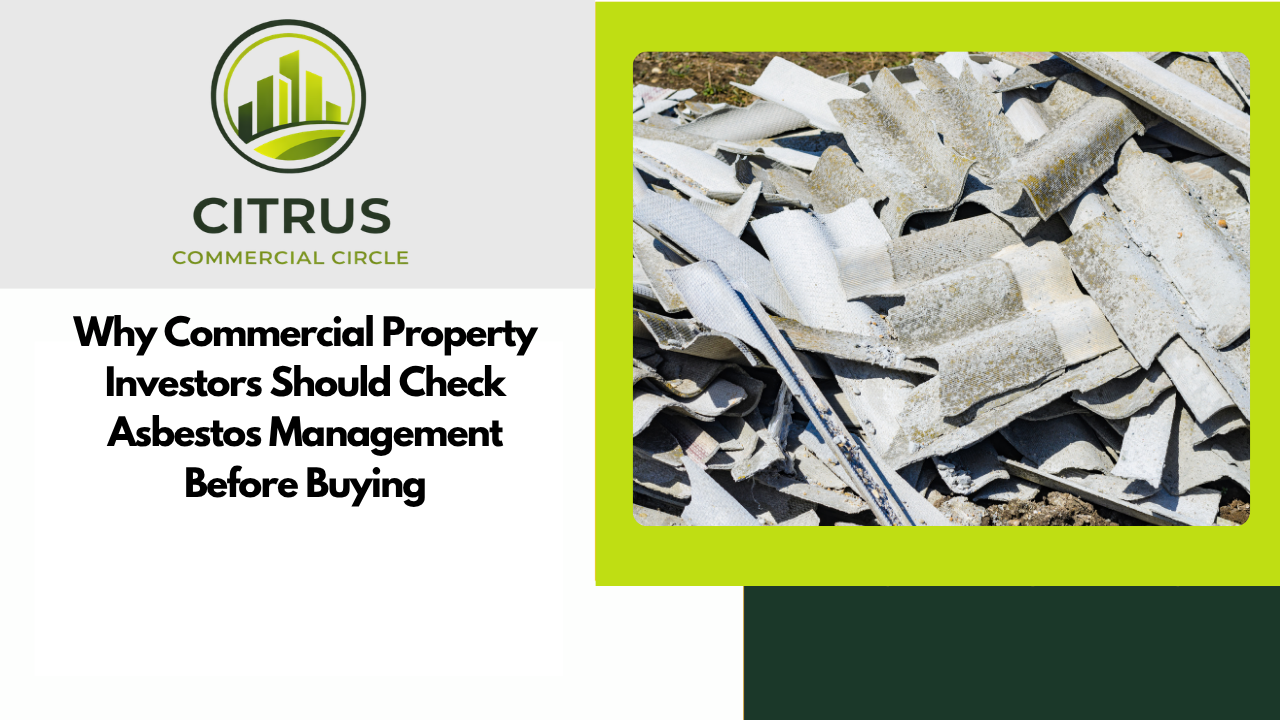
Why Commercial Property Investors Should Check Asbestos Management Before Buying
Asbestos can be an invisible commercial property risk that becomes expensive when refurbishment begins
When investors inspect commercial property, they usually focus on what is immediately visible.
The roof condition, floor slab, yard, loading access, electrical supply and general state of repair all tend to receive attention.
But in many older commercial buildings, one of the most important risks may be hidden within the building fabric:
asbestos-containing materials.
Asbestos was widely used in UK construction before its eventual prohibition. As a result, many industrial units, offices, workshops, warehouses and older commercial buildings may still contain asbestos-containing materials.
That does not automatically make a property unsuitable for investment.
In many cases, asbestos can remain safely managed in place.
The difficulty arises when investors do not know it is there, do not understand its condition or begin refurbishment works without appropriate investigation.
For commercial property investors across Bury, North Manchester and the wider North West, asbestos due diligence should therefore be considered seriously when purchasing older commercial stock.
Why asbestos matters in commercial property investment
Asbestos is fundamentally a health-and-safety issue.
But for an investor, it can also become a:
- Capital expenditure issue
- Refurbishment issue
- Lease-management issue
- Development issue
- Transaction issue
A building that appears inexpensive to refurbish can become considerably more expensive if asbestos removal is required before works can proceed.
This is why investors should investigate the position before finalising the acquisition budget.
Which commercial buildings may contain asbestos?
Asbestos was historically incorporated into a wide range of construction products.
Older commercial buildings may therefore contain asbestos within materials such as:
- Roof sheets
- Ceiling tiles
- Insulation
- Pipe lagging
- Floor tiles
- Wall panels
- Fireproofing products
- Textured coatings
Its presence cannot always be confirmed simply by looking at a material.
Professional assessment is therefore important.
The age of the building should trigger questions
The Health and Safety Executive states that buildings constructed or refurbished before the year 2000 may potentially contain asbestos.
Official guidance is available through the Health and Safety Executive (HSE).
For investors purchasing older commercial property, one of the first questions should therefore be:
Is there an asbestos survey?
If there is, obtain it.
If there isn’t, determine whether one should be commissioned.
What is an asbestos survey?
An asbestos survey is an inspection designed to identify materials that may contain asbestos and assess relevant risks.
Different types of asbestos survey are appropriate in different circumstances.
The two broad categories investors commonly encounter are:
- Management surveys
- Refurbishment and demolition surveys
Understanding the difference is important.
What is an asbestos management survey?
A management survey is generally intended to help manage asbestos-containing materials during the normal occupation and use of a building.
It can identify materials that could be disturbed through:
- Everyday occupation
- Routine maintenance
- Minor works
For an investment property that will remain broadly as it is, this type of information can help landlords and occupiers manage the building safely.
What is a refurbishment and demolition survey?
Where significant works are planned, a more intrusive investigation may be required.
A refurbishment and demolition survey is designed to locate asbestos-containing materials within areas where substantial work will take place.
This becomes particularly important where the investor intends to:
- Strip out the building
- Remove ceilings
- Alter walls
- Replace services
- Extend the property
- Demolish structures
A basic management survey may not provide enough information for that work.
Don’t assume an existing survey covers your refurbishment
This is a common mistake.
A seller may provide an asbestos survey and the buyer may think:
“That’s sorted.”
But investors should check:
- What type of survey is it?
- How old is it?
- Which areas were inspected?
- Were any areas inaccessible?
- Does it cover the proposed works?
The existence of a report does not automatically mean every future project is covered.
Asbestos does not always need to be removed
The presence of asbestos can sound alarming.
However, asbestos-containing materials that are in good condition and unlikely to be disturbed may sometimes be managed rather than immediately removed.
The appropriate approach depends on:
- Type of material
- Condition
- Location
- Likelihood of disturbance
Professional advice should determine the correct strategy.
Condition matters
Two commercial properties could contain similar materials but present very different management issues.
Property A may contain asbestos cement roof sheets in reasonable condition.
Property B may contain badly damaged or deteriorating asbestos-containing materials.
The second situation may require more urgent action.
Investors therefore need information about both:
presence
and
condition.
Refurbishment is where hidden costs often appear
Imagine purchasing a dated 20,000 sq ft industrial building.
The investment plan is straightforward:
- Remove the old office accommodation
- Replace ceilings
- Upgrade lighting
- Install new toilets
- Reconfigure the warehouse
The investor budgets £250,000.
Then intrusive surveys identify asbestos within several areas due to be disturbed.
Additional removal and specialist works increase the project cost materially.
The refurbishment may still be viable.
But the purchase appraisal would have been stronger if those costs had been identified before completion.
Demolition can increase asbestos exposure significantly
An investor buying a site for redevelopment may care relatively little about the condition of the existing building because it will eventually be demolished.
But demolition itself can expose asbestos-containing materials.
The investor may therefore incur removal costs before the site can be cleared.
For redevelopment property, asbestos should be considered part of demolition cost planning.
Old industrial roofs deserve particular attention
Many older industrial buildings across the UK contain corrugated cement roof products.
Some may contain asbestos.
This matters because investors frequently plan to:
- Replace roofs
- Install roof lights
- Add solar panels
- Penetrate roof sheets
Before works are commissioned, the roof construction needs to be understood.
Solar projects can trigger asbestos considerations
Commercial landlords increasingly look at solar photovoltaic installations.
This can be particularly attractive on warehouses with large roof areas.
But if the roof contains asbestos-containing materials, the project may become more complicated.
Investors may need to consider:
- Roof condition
- Safe access
- Fixing methods
- Remaining roof life
Installing a long-term solar system onto an ageing roof that will soon require replacement may be poor capital planning.
Sometimes the best strategy is to combine projects
Suppose a warehouse roof is approaching the end of its useful life and the investor also wants solar panels.
Rather than dealing with the projects separately, it may be more efficient to assess:
- Asbestos implications
- Roof replacement
- Solar installation
as one coordinated capital programme.
This can reduce duplicated costs and disruption.
Don’t drill first and investigate later
Many commercial refurbishment works involve cutting, drilling or disturbing existing materials.
This might include installing:
- CCTV
- Signage
- Electrical equipment
- Fire alarms
- Data cabling
Where asbestos-containing materials may be present, seemingly minor works can still require proper controls.
Landlords should therefore ensure contractors are provided with appropriate asbestos information before work begins.
The duty to manage asbestos can apply to commercial premises
The UK’s asbestos regulations include duties concerning the management of asbestos in non-domestic premises.
Depending on the circumstances, responsibility can fall on the person or organisation that has maintenance or repair responsibilities for the premises.
This could potentially involve:
- Landlords
- Tenants
- Managing parties
The precise responsibilities should be established from the lease and the circumstances.
Investors should not simply assume the tenant deals with everything.
Lease wording becomes important
Some commercial leases place extensive repair and maintenance responsibilities on tenants.
Others leave significant responsibility with the landlord.
In multi-let property, the landlord commonly retains responsibility for parts such as:
- Roof
- Structure
- Common areas
Asbestos management should therefore be considered alongside the actual repairing structure within the leases.
Multi-let properties can create additional complexity
Imagine an industrial estate containing ten units.
The landlord may control:
- External roofs
- Estate infrastructure
- Common access
Individual tenants control their own internal areas.
Different asbestos-containing materials could exist across several locations.
A clear property-wide management strategy helps avoid confusion.
Keep an asbestos register
Where asbestos-containing materials are identified, appropriate records should be maintained.
An asbestos register can help document:
- Location
- Type
- Condition
It should then be updated where circumstances change.
For property investors with multiple buildings, organised records can significantly improve estate management.
Contractors need the right information
A contractor arriving to install new lights should not have to discover asbestos risks halfway through the work.
Good landlords provide relevant information before contractors begin.
This protects:
- Workers
- Occupiers
- The landlord
It can also reduce unexpected project delays.
Poor documentation creates uncertainty
Some older commercial properties have passed through numerous owners and tenants.
Over the years, documentation may become incomplete.
An investor might receive:
- One old survey
- No asbestos register
- Incomplete maintenance records
That does not necessarily mean the building has a serious problem.
But uncertainty should be reflected in due diligence.
Don’t rely solely on what the seller says
A seller may genuinely believe the building contains no asbestos.
But unless there is appropriate evidence, that statement should not replace professional investigation.
Property investment should be based on documented information wherever possible.
Asbestos removal is specialist work
Where removal is required, the work needs to be undertaken appropriately.
Some asbestos work may require licensed contractors, depending on the material and nature of the works.
Investors should rely on competent specialists and official HSE guidance.
Trying to minimise cost by using inappropriate contractors can create much greater problems.
Removal cost varies significantly
There is no single “asbestos removal cost per square foot” that applies to every commercial property.
Cost can depend on:
- Material
- Quantity
- Access
- Condition
- Work method
- Disposal requirements
Investors should obtain project-specific quotations where asbestos forms a material part of the acquisition decision.
Programme delays can be as important as removal cost
Suppose removal costs £30,000.
That number may appear manageable.
But if it delays the refurbishment by six weeks, the total commercial impact may also include:
- Lost rent
- Finance costs
- Contractor disruption
- Delayed tenant occupation
Investors should therefore assess both:
direct removal cost
and
programme impact.
Asbestos can affect a tenant’s move-in programme
A landlord may agree a letting subject to refurbishment.
If asbestos is then discovered unexpectedly during works, occupation can be delayed.
This creates pressure from:
- Tenant
- Contractor
- Agent
Proper investigation before committing to a programme can reduce that risk.
Incentive periods can be affected too
Commercial tenants may receive rent-free periods partly to complete fit-out.
Unexpected asbestos issues can prevent the tenant from carrying out those works as planned.
This can create disagreement over who bears the resulting delay.
Clear information before lease completion is therefore valuable.
Development appraisals should include asbestos
A redevelopment appraisal normally considers:
- Purchase price
- Professional fees
- Construction
- Finance
- Planning
- Contingency
Where older buildings exist, demolition and asbestos-related costs should also be considered.
Ignoring them can overstate the site’s residual value.
A cheap old building may not be cheap to clear
This is particularly relevant to redevelopment investors.
A tired warehouse may appear to have very little existing building value.
But the cost of safely clearing that building can still be substantial.
Land value should therefore be considered net of realistic site-clearance costs.
Asbestos can influence negotiation
If due diligence identifies asbestos requiring significant expenditure, an investor may reconsider:
- Purchase price
- Refurbishment budget
- Programme
The issue does not automatically kill the transaction.
It simply becomes another quantified investment cost.
This is exactly why due diligence exists.
Known risk is easier to price than unknown risk
Investors often worry about an asbestos survey identifying something.
But identifying an issue can actually improve decision-making.
Once the position is understood, the investor can obtain:
- Removal quotes
- Professional advice
- Programme estimates
That allows the risk to be priced.
Unknown issues are far harder to manage.
Asbestos can sometimes be left safely within an investment
If asbestos-containing materials are:
- In good condition
- Properly recorded
- Appropriately managed
- Unlikely to be disturbed
there may be no immediate commercial need to remove them.
Investors should avoid unnecessary capital expenditure where professional advice supports continued management.
But future plans matter
A material that can safely remain today may need removal when the building is refurbished five years later.
A long-term asset plan should therefore record where future capital expenditure may arise.
Buyers should check historic removal records
If previous asbestos removal has already taken place, obtain whatever records are available.
These may help show:
- What was removed
- Where work occurred
- Who carried it out
But don’t automatically assume all asbestos has therefore disappeared from the property.
Future surveys may still be required.
Older plant rooms can warrant particular care
Commercial buildings can contain historic:
- Boilers
- Heating equipment
- Pipework
Older plant areas may potentially contain materials associated with thermal insulation or fire protection.
These areas should not be overlooked simply because tenants rarely enter them.
Vacant buildings still require management
An empty property is not automatically risk-free.
Maintenance teams, security contractors and prospective refurbishment contractors may still enter the building.
Landlords should retain appropriate information even during void periods.
Emergency repairs can be complicated by poor asbestos records
Imagine a water pipe bursts inside an older warehouse.
A contractor needs to open up a wall immediately.
If the landlord has no asbestos information, the repair becomes more difficult.
Good property records therefore improve everyday operational resilience.
Property managers need access to the records
For larger portfolios, asbestos documentation should not exist only within an old solicitor’s file.
The people managing the building need practical access to the relevant information.
Good systems make compliance easier.
Tenants should understand their responsibilities
Commercial tenants may also need asbestos information depending on their repairing and maintenance obligations.
The landlord and tenant should understand who manages which parts of the property.
Confusion creates risk.
Fit-out contractors should not work from assumptions
Incoming tenants frequently appoint their own contractors to:
- Partition offices
- Install kitchens
- Add signs
- Alter electrical systems
Landlords should make sure relevant asbestos information is considered through the licence or consent process where appropriate.
Asbestos can interact with dilapidations
At lease expiry, questions can arise about tenant alterations and reinstatement.
If a tenant has installed works around asbestos-containing materials, removal may become complicated.
This is another reason for alteration documentation to be maintained properly throughout the lease.
Surveys should be carried out by competent professionals
The quality of an asbestos survey matters.
Commercial investors should look for appropriately competent specialists and ensure the survey scope reflects the intended purpose.
The Health and Safety Executive provides official guidance on asbestos management and surveying.
Don’t confuse asbestos with contamination
Asbestos within a building is different from contaminated land.
However, asbestos-containing materials can sometimes also be found within demolition rubble or made ground on redevelopment sites.
Where an investor is purchasing land with a substantial industrial history, both building and environmental investigations may therefore be required.
Ground surveys and building surveys serve different purposes
A conventional building survey may identify suspected materials and recommend specialist investigation.
It should not necessarily be treated as a substitute for a dedicated asbestos survey.
Investors should understand the scope of every report they commission.
Asbestos can influence lender due diligence
Commercial lenders may take an interest in significant building defects or environmental risks affecting their security.
Where asbestos requires substantial immediate expenditure, this may influence:
- Valuation
- Refurbishment budgets
- Lending conditions
Providing clear information early can reduce transaction uncertainty.
Insurers should receive accurate information
Commercial property insurance depends on accurate disclosure of material information.
Where substantial refurbishment or removal work is planned, investors should ensure appropriate insurance arrangements are in place for the works.
Contractors should also carry the necessary cover for their activities.
Health and safety should remain the priority
Although this article focuses on property investment, asbestos should never be treated purely as a financial consideration.
Exposure can cause serious disease.
Commercial decisions around asbestos must therefore start with appropriate health-and-safety management.
The Health and Safety Executive – Asbestos provides detailed official guidance for businesses and dutyholders.
Asbestos does not automatically make old commercial property unattractive
This distinction is important.
Many successful commercial buildings contain asbestos-containing materials that are appropriately managed.
Investors should therefore avoid two extremes:
Ignoring asbestos completely
or
Rejecting every building where asbestos is identified.
The correct response is informed risk management.
North Manchester’s industrial heritage makes due diligence particularly relevant
Bury, Manchester and surrounding North West towns contain substantial older industrial property stock.
Former mills, engineering premises, workshops and warehouses can provide excellent commercial accommodation.
Many have characteristics modern occupiers value, including:
- Strong structures
- Large floorplates
- Good yards
- Established locations
But older construction also makes appropriate building investigation particularly important.
Refurbishment can unlock significant value
An older property containing asbestos can still be a very successful investment if the investor understands the costs before buying.
For example:
Purchase tired industrial building.
Complete specialist surveys.
Remove problematic materials.
Upgrade roof and services.
Re-let improved building.
The presence of asbestos does not prevent value creation.
Poor planning does.
Build survey costs into acquisition due diligence
Investors sometimes hesitate to spend money investigating a property they have not yet purchased.
But commissioning appropriate surveys before completion can prevent much larger losses afterwards.
Due diligence expenditure should be considered part of professional investment decision-making.
What should commercial property investors ask?
Before buying an older property, consider questions such as:
- When was the building constructed?
- Has it been significantly refurbished?
- Is an asbestos management survey available?
- When was it completed?
- Is there an asbestos register?
- Are identified materials in good condition?
- Have any materials previously been removed?
- Are intrusive works planned?
- Is a refurbishment and demolition survey required?
- What are the likely removal costs?
- Who has responsibility under the existing leases?
The appropriate level of investigation will depend on the property and investment plan.
Don’t forget outbuildings
Commercial sites often contain structures that receive little attention during a viewing.
Examples include:
- Garages
- Stores
- Workshops
- Plant rooms
- Covered areas
Older secondary buildings can still contain asbestos-containing materials.
The entire acquisition should therefore be considered, not just the main warehouse.
Landlord-owned common areas matter too
Within a multi-let property, investors should inspect areas such as:
- Corridors
- Stairwells
- Plant areas
- Roof spaces
These may remain directly under landlord control.
Management obligations therefore need to be clear.
Documentation can improve future saleability
A future purchaser will ask many of the same questions.
An investor who maintains organised asbestos records can provide a clearer due-diligence package when the property is later:
- Sold
- Refinanced
- Re-let
Good documentation supports good asset management.
Citrus Commercial Circle’s market insight
At Citrus Commercial Circle, we believe investors should never look at an older commercial property and ask only:
“How much will it cost to make this look better?”
The stronger question is:
“What needs to happen behind the finishes before the refurbishment can safely begin?”
Asbestos is a perfect example.
A new ceiling, modern lighting and freshly decorated offices may be the visible result.
But proper investigation and management of the existing building fabric is what allows those improvements to happen safely and predictably.
Commercial investors who understand these hidden costs can appraise refurbishment opportunities far more accurately.
Final thoughts
Asbestos is common within older commercial property and its presence does not automatically make a building unsuitable for investment.
What matters is understanding:
- What is present
- Where it is located
- What condition it is in
- Whether it will be disturbed
- What management or removal will cost
Appropriate surveys can turn an uncertain risk into a manageable investment consideration.
For refurbishment and redevelopment opportunities in particular, identifying asbestos before completion can help investors build realistic budgets, avoid programme delays and reduce unpleasant surprises once work begins.
At Citrus Commercial Circle, we help landlords and investors across Bury and North Manchester understand the practical property issues that sit behind successful commercial investment decisions.
Based in Bury. Active across North Manchester. Always on your side.
Call us today: 0161 383 1806
Email: info@citruscommercialcircle.co.uk
Visit: citruscommercialcircle.co.uk
Let’s unlock the full potential together.
Citrus Commercial Circle – Where standards meet success.