

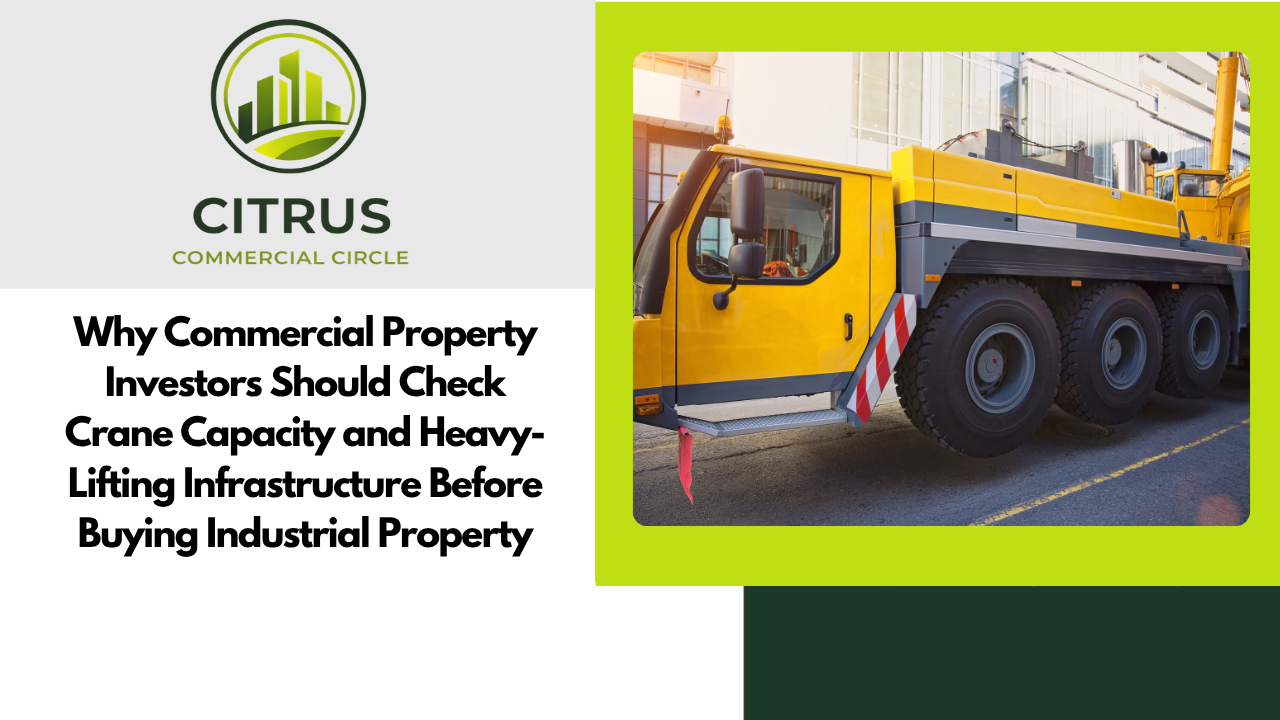
Why Commercial Property Investors Should Check Crane Capacity and Heavy-Lifting Infrastructure Before Buying Industrial Property
Some industrial buildings are worth more because of what they can lift, not simply how much space they provide
When investors compare industrial properties, the conversation normally centres around familiar specifications:
- Floor area
- Eaves height
- Yard size
- Roller-shutter access
- Three-phase electricity
- Motorway connectivity
But within certain areas of manufacturing, engineering and fabrication, another feature can dramatically influence whether a building is suitable:
heavy-lifting infrastructure.
Overhead cranes, gantry cranes, reinforced floors and suitable loading arrangements can transform an ordinary industrial building into highly specialised operational accommodation.
For commercial property investors across Bury, North Manchester and the wider North West, understanding existing crane infrastructure—and the occupier market that requires it—can reveal opportunities that aren’t obvious from square footage alone.
What is an overhead crane?
An overhead crane is a lifting system commonly used within industrial buildings to move heavy materials or equipment around the premises.
Depending on the installation, the crane may travel along rails positioned along the building structure, allowing loads to be moved across substantial parts of the warehouse or production area.
They are commonly associated with industries such as:
- Engineering
- Steel fabrication
- Heavy manufacturing
- Machinery production
- Metalworking
- Industrial maintenance
For businesses within these sectors, suitable crane infrastructure can be a fundamental property requirement.
Why can an existing crane be valuable?
Installing a substantial crane system into an industrial building can involve considerable expenditure and technical work.
The occupier may need to consider:
- Structural capacity
- Crane rails
- Electrical supply
- Installation
- Testing
- Safety systems
- Professional design
A building already configured for heavy lifting may therefore save an incoming occupier significant time and capital expenditure.
That can create a competitive advantage in the letting market.
But don’t assume every crane adds value
A crane sitting inside a warehouse is not automatically valuable.
Investors need to establish:
- Who owns it
- Its lifting capacity
- Its age
- Whether it operates
- Its maintenance history
- Whether documentation exists
An obsolete or defective installation could become a liability rather than an asset.
Establish who actually owns the equipment
This is an important acquisition question.
Industrial machinery located inside a property may belong to:
- The landlord
- The tenant
- A finance company
- Another third party
Never assume that equipment physically attached to a building automatically forms part of the property purchase.
The legal position should be established during due diligence.
Crane capacity matters
Overhead cranes are generally rated according to the maximum load they are designed to lift safely.
Different occupiers may require completely different capacities.
A light engineering company might require relatively modest lifting capability.
A heavy fabrication business may require substantially more.
The specification should therefore be clearly established before marketing the property as crane-equipped accommodation.
Testing and inspection records are essential
Lifting equipment used in workplaces is subject to health and safety requirements.
The Health and Safety Executive – Lifting Operations and Lifting Equipment Regulations (LOLER) provides official guidance concerning lifting equipment used at work.
Investors acquiring existing equipment should obtain appropriate professional advice concerning inspection, testing and ongoing responsibilities.
A crane may depend on the building structure
Some overhead crane installations use rails supported by the main building structure.
This means the property itself may have been specifically engineered to accommodate crane loads.
Investors should establish whether:
- Structural calculations exist
- Crane beams have been modified
- Previous alterations were professionally designed
The structural capability of the building can potentially be as valuable as the crane itself.
Crane-ready buildings can have value even without the crane
Suppose a previous tenant removes its crane when leaving.
The building may still retain:
- Crane rails
- Structural supports
- Suitable power
- Appropriate clear height
An incoming engineering company could potentially install replacement lifting equipment more easily than it could within a completely standard warehouse.
This means investors should understand the underlying infrastructure, not simply the equipment currently present.
Eaves height becomes particularly important
Industrial occupiers using overhead lifting systems need sufficient internal height.
A warehouse with good eaves height can potentially accommodate:
- Crane equipment
- Tall machinery
- Large fabricated components
while still maintaining usable operational clearance.
This is one reason high-clearance industrial buildings can appeal to a wider range of occupiers.
Hook height can matter more than eaves height
For crane users, the headline eaves measurement may not tell the complete story.
The practical question is:
How high can the crane actually lift the load?
The usable hook height may be influenced by:
- Crane design
- Roof structure
- Rails
- Machinery
Agents marketing specialist industrial accommodation should therefore obtain accurate technical information.
Floor loading is equally important
Heavy engineering businesses do not only lift heavy items.
They may also place extremely heavy:
- Machinery
- Materials
- Fabricated components
onto the floor.
Investors should therefore understand whether the industrial slab is suitable for the intended use.
A visually good concrete floor does not automatically mean it can accommodate every load.
Machinery foundations can add or reduce value
Some industrial buildings contain substantial concrete bases installed for previous machinery.
These could potentially benefit another manufacturing occupier.
Alternatively, they may obstruct a new tenant’s layout and require removal.
Investors should consider whether specialist infrastructure is reusable or simply expensive to remove.
Three-phase electricity often goes hand in hand with heavy engineering
Businesses requiring cranes frequently also operate energy-intensive machinery.
They may require substantial electrical capacity for:
- CNC machinery
- Welding equipment
- Compressors
- Extraction
- Production lines
Simply advertising “three-phase power” may not provide enough information.
The available electrical capacity can be a major occupier consideration.
Power capacity should be verified
Investors should establish the actual supply available to the premises where it is relevant.
Increasing power capacity after purchase can potentially involve:
- Network applications
- Infrastructure upgrades
- New switchgear
- Significant lead times
The Electricity North West network serves much of North West England and provides information concerning electricity connections and network services.
Existing capacity can therefore represent a genuine industrial property advantage.
Large roller shutters matter too
A business may be able to manufacture or lift a huge component inside the building.
But can it actually get that component outside?
Large engineering operations may require generous:
- Door height
- Door width
- Loading areas
The entire movement route needs to work.
Think about the journey from HGV to production floor
When assessing specialist industrial property, investors should imagine the actual operational process.
A delivery arrives on an articulated HGV.
Can it:
- Enter the estate?
- Turn within the yard?
- Reach the loading door?
- Unload safely?
- Move materials into the crane operating area?
Industrial property functionality is about how all these elements work together.
Yard space can therefore become essential
Heavy industrial occupiers may require yards for:
- HGV manoeuvring
- Loading
- Material storage
- Finished products
A crane-equipped building with virtually no external circulation space could still have significant operational limitations.
Investors should assess the complete property.
External cranes can create another specialist feature
Some industrial sites contain external gantries or lifting systems.
These can potentially support:
- Steel handling
- Fabrication
- Heavy storage
But external installations bring additional considerations around:
- Weather
- Maintenance
- Safety
- Structural condition
Specialist inspection is essential.
Crane infrastructure can create a strong tenant “stickiness”
Heavy industrial businesses can invest substantial amounts fitting out their premises.
Relocating may involve moving:
- Machinery
- Cranes
- Production equipment
- Electrical infrastructure
This can be expensive and disruptive.
Where the building closely matches the occupier’s operational needs, the tenant may therefore have strong reasons to remain.
For investors, this can potentially support long-term tenant retention.
But specialist buildings can also create reletting risk
There is another side to this.
A building designed around a highly specialist industrial operation may appeal to a smaller occupier market.
If the tenant leaves, the landlord needs to understand:
Who else could use this building?
Investors should balance specialist value with alternative-use flexibility.
The ideal building can appeal to both specialist and general occupiers
A strong industrial investment may contain specialist infrastructure without being completely dependent on it.
For example, a warehouse could have:
- Good eaves height
- Strong floor
- Large doors
- Excellent power
- Crane rails
while remaining usable as conventional warehouse accommodation if required.
That flexibility can reduce reletting risk.
Don’t remove specialist infrastructure automatically
When an engineering tenant leaves, landlords sometimes strip the building back immediately.
That may be appropriate.
But before removing crane rails or other specialist infrastructure, investors should consider whether those features could attract another engineering or manufacturing business.
Something that appears redundant may actually differentiate the property.
Market the specification properly
Specialist industrial properties need detailed marketing.
Instead of simply saying:
“Industrial unit – 20,000 sq ft”
particulars might appropriately highlight verified features such as:
- Crane capacity
- Hook height
- Eaves height
- Power capacity
- Roller-shutter dimensions
- Yard depth
- Floor specification
The more specialist the target occupier, the more useful accurate technical information becomes.
Technical details can improve online search visibility
Businesses searching for industrial premises may use highly specific terms.
For example:
- “Warehouse with overhead crane Manchester”
- “Engineering unit with crane North West”
- “Heavy industrial unit three phase power”
- “High power industrial unit Manchester”
Detailed property marketing can help capture these more targeted enquiries.
Engineering remains important to the North West economy
The North West has a substantial history of engineering and manufacturing.
Modern industrial occupiers continue to operate across sectors including:
- Aerospace supply chains
- Automotive
- Precision engineering
- Advanced manufacturing
- Metal fabrication
Major manufacturers such as BAE Systems and Rolls-Royce illustrate the scale and sophistication of UK engineering supply chains.
These major companies are supported by networks of specialist SMEs requiring suitable industrial premises.
SMEs can have highly specialised property requirements
A relatively small engineering business might only employ twenty people.
But its property requirements could still include:
- Heavy power
- Crane capacity
- Secure yard
- High eaves
- Large loading access
Employee numbers therefore do not necessarily indicate the complexity of the building specification required.
Industrial agents should understand operational requirements
When dealing with manufacturing businesses, asking only:
“How many square feet do you need?”
isn’t enough.
Better questions include:
- What power do you require?
- Do you need cranes?
- What machinery will you install?
- What HGV access do you need?
- What floor loading is required?
- What clear height do you need?
This helps match businesses with genuinely suitable premises.
Crane infrastructure can influence refurbishment strategy
An investor purchasing a tired engineering building may decide to retain and refurbish the existing crane infrastructure rather than removing it.
Alternatively, professional assessment may conclude that replacement is more sensible.
The decision should be based on:
- Condition
- Cost
- Market demand
- Future strategy
rather than appearance alone.
Maintenance costs need to be included
Specialist equipment creates ongoing responsibilities.
Depending on ownership and lease arrangements, expenditure might include:
- Inspection
- Servicing
- Repairs
- Certification
Investors should establish who is responsible for those costs.
Lease drafting becomes particularly important
Where substantial equipment remains with the building, the lease should clearly address relevant responsibilities.
Questions may include:
- Who maintains it?
- Who inspects it?
- Who repairs it?
- Who replaces it?
- What happens at lease expiry?
Commercial property solicitors should ensure the documentation reflects the actual arrangement.
Tenant-owned equipment should also be documented
Where the tenant installs its own crane, the landlord should understand what happens when the tenancy ends.
Does the tenant:
- Remove it?
- Leave it?
- Reinstate the building?
These matters should be agreed before installation rather than years later when the tenant is leaving.
Licence to Alter may be required
Installing major crane infrastructure is not a minor alteration.
Depending on the lease, formal landlord consent may be required through a Licence to Alter.
The landlord may need professional input concerning:
- Structure
- Design
- Insurance
- Reinstatement
This protects the long-term asset.
Building insurance needs consideration
Significant industrial equipment and manufacturing activities can affect the property’s risk profile.
Landlords should ensure insurers are provided with appropriate information.
The building use, rather than simply the physical presence of a crane, may be relevant to insurance arrangements.
Health and safety responsibility should be clear
Industrial lifting operations can involve serious risks.
Businesses operating lifting equipment need to comply with relevant workplace safety obligations.
The Health and Safety Executive provides extensive official guidance for employers and businesses operating machinery and lifting equipment.
Landlords should not attempt to replace specialist health-and-safety advice.
Acquisition surveys should include specialist infrastructure
A standard commercial building survey may identify that cranes are present.
But a purchaser wanting to rely on that equipment may require additional specialist inspection.
The investor needs to know whether the feature being included in the investment appraisal is actually usable.
Documentation can add value
A well-managed specialist industrial property may have records including:
- Structural information
- Crane specifications
- Inspection records
- Electrical information
- Maintenance history
Good documentation reduces uncertainty for both investors and incoming tenants.
Missing paperwork should affect the appraisal
If a seller says:
“It’s got a ten-tonne crane.”
but cannot provide any supporting information, the investor should not automatically assign substantial value to it.
Verify first.
Value second.
Specialist industrial infrastructure can support rental premiums
Where demand exists, a well-equipped industrial building may command stronger interest than a basic shell.
An occupier comparing two buildings may be willing to pay more for the one that avoids substantial installation costs.
Whether this translates into higher rent depends on the local market and individual property.
It can also reduce void periods
Sometimes the greatest value isn’t a rental premium.
It is finding the right tenant more quickly.
If a crane-equipped engineering unit attracts a business that would otherwise struggle to find suitable premises, the landlord may reduce vacancy.
Shorter voids can have a major effect on investment performance.
Understand the replacement cost
Investors should consider what it would cost to recreate the property’s specialist specification elsewhere.
If another building would require substantial investment to achieve the same:
- Power
- Crane capacity
- Floor strength
- Loading access
the existing infrastructure may have significant occupational value.
But replacement cost does not automatically equal property value
A previous owner may have spent £500,000 installing specialist equipment.
That does not mean the property is automatically worth £500,000 more.
Value depends on whether the market actually requires the improvements.
Commercial property investment should always remain demand-led.
North Manchester’s established industrial stock can contain hidden advantages
Older industrial buildings across Bury and North Manchester are sometimes dismissed because they lack the appearance of modern distribution warehouses.
But established engineering buildings can contain valuable infrastructure that would be expensive to reproduce today.
This might include:
- Heavy power
- Crane beams
- Reinforced floors
- Large yards
- Substantial structures
Investors should understand what they are looking at before assuming newer always means better.
Citrus Commercial Circle’s market insight
At Citrus Commercial Circle, we believe industrial investors should look beyond square footage.
Two 20,000 sq ft warehouses can be completely different assets.
One might offer little more than basic storage accommodation.
The other could contain the infrastructure required by a specialist engineering business that has very few alternative premises available.
Understanding:
who needs the building
and
what would it cost them to recreate its specification elsewhere
can reveal value that a basic £-per-square-foot comparison misses.
Final thoughts
Overhead cranes and heavy-lifting infrastructure will not matter to every industrial occupier.
But for the businesses that require them, they can be fundamental.
Investors considering specialist industrial property should establish equipment ownership, lifting capacity, structural capability, inspection history, power supply and ongoing maintenance responsibilities before assigning value to the infrastructure.
The strongest industrial investments often combine specialist functionality with enough flexibility to appeal to alternative occupiers in the future.
At Citrus Commercial Circle, we help landlords and investors across Bury and North Manchester understand the operational details that influence real industrial property demand.
Based in Bury. Active across North Manchester. Always on your side.
Call us today: 0161 383 1806
Email: info@citruscommercialcircle.co.uk
Visit: citruscommercialcircle.co.uk
Let’s unlock the full potential together.
Citrus Commercial Circle – Where standards meet success.