

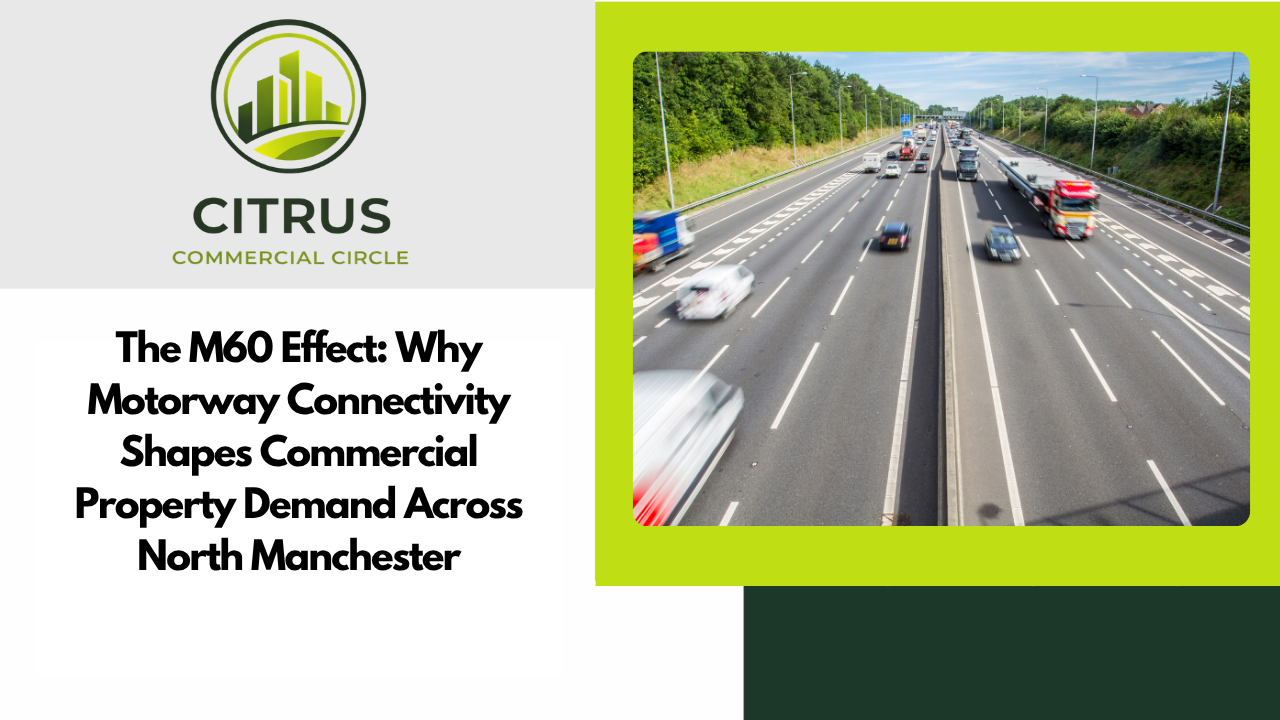
The M60 Effect: Why Motorway Connectivity Shapes Commercial Property Demand Across North Manchester
Commercial property is often described in terms of postcode.
Bury.
Oldham.
Rochdale.
Salford.
North Manchester.
But businesses choosing industrial and warehouse premises frequently think differently.
They think in:
Minutes.
How quickly can a van reach the motorway?
How long does a delivery take to Manchester city centre?
How easily can an HGV reach the site?
How practical is the journey for employees?
This is why the M60 and the wider motorway network have such an important relationship with commercial property demand across North Manchester.
For many businesses, the question is not simply:
“Which town are we located in?”
It is:
“How connected is this building to the places our business needs to reach?”
That difference can have a major influence on industrial, warehouse, trade-counter and distribution property.
Commercial Property Is About Movement
A warehouse exists to store goods.
But those goods rarely stay there permanently.
They arrive.
They are processed or stored.
Then they leave.
The commercial property therefore sits inside a wider transport network.
Location Should Be Measured Operationally
Two warehouses may be only five miles apart.
Yet one might offer dramatically better access to:
- Motorways
- Customers
- Suppliers
Distance alone does not tell the whole story.
The M60 Creates a Strategic Ring Around Greater Manchester
The M60 provides orbital motorway connectivity around Greater Manchester.
It links with other major routes serving the wider region.
For commercial occupiers, this can make locations around the motorway particularly practical.
Connections Extend Beyond the M60
The wider motorway network includes important routes such as:
- M62
- M66
- M61
- M602
Together, these routes help connect North Manchester with surrounding towns, cities and regional markets.
Why This Matters to Businesses
Imagine a company operating 15 vans.
Each van completes several journeys every day.
Saving even a relatively small amount of travel time on each journey can accumulate across:
- Days
- Weeks
- Years
Location can therefore influence operating efficiency.
Rent Is Only One Property Cost
Businesses often compare premises primarily by annual rent.
But property location can influence:
- Fuel
- Driver time
- Vehicle utilisation
- Delivery efficiency
A cheaper building can create higher operating costs.
Consider the Cost Per Journey
Suppose Property A saves £10,000 per year in rent.
But the business’s vehicles collectively spend hundreds of additional hours each year travelling through congestion to reach major routes.
The rental saving may become less significant.
Industrial Occupiers Understand This Instinctively
This is why businesses often ask commercial agents:
“How far is it from the motorway?”
They are not making casual conversation.
They are assessing operating cost.
The Final Mile to the Motorway Matters
A building can technically be close to a motorway junction but still have poor access.
Potential problems include:
- Narrow roads
- Congested junctions
- Residential streets
- Weight restrictions
Always test the actual route.
Drive It in a Commercial Vehicle if Necessary
For businesses using:
- HGVs
- Large vans
- Trailers
the route should be assessed from an operational perspective.
A road that feels easy in a car may be very different in a large vehicle.
Junction Access Can Influence Industrial Demand
Properties close to effective motorway junctions can appeal to businesses needing regular regional travel.
Potential occupiers include:
- Distributors
- Wholesalers
- Contractors
- E-commerce businesses
- Trade suppliers
These companies value connectivity differently from a purely office-based business.
Bury Benefits From M66 Connectivity
Bury’s commercial property market benefits from access to the M66 and connections into the wider motorway network.
This helps businesses reach:
- Manchester
- Lancashire
- Greater Manchester
without necessarily locating in the city centre.
Industrial Locations Do Not Need City-Centre Addresses
A business distributing goods does not necessarily benefit from paying for a prestigious central Manchester postcode.
It may gain more from:
- Better yard space
- Easier parking
- Faster motorway access
This is one reason industrial activity naturally clusters outside dense city centres.
Rochdale Has Strong Strategic Connections
Rochdale’s relationship with the M62 is particularly important for industrial and logistics occupiers.
The M62 provides east-west connectivity across northern England.
For businesses distributing regionally, this can be a significant advantage.
Oldham Also Benefits From Wider Network Access
Oldham’s industrial areas can provide access towards:
- M60
- M62
depending on location.
Again, the precise route from the property matters.
Salford Connects to Major Regional Routes
Commercial areas across Salford and the western side of Greater Manchester can benefit from connections towards:
- M60
- M61
- M602
This can make them attractive for businesses serving Manchester and the wider North West.
North Manchester Sits Between Multiple Markets
This is one of the region’s strengths.
Businesses can potentially serve:
- Manchester city centre
- Lancashire
- West Yorkshire
- Wider North West
from one operational base.
Distribution Is About Reach
A warehouse’s value to a distributor depends partly on how many customers can be reached efficiently.
This is why logistics businesses often analyse:
- Drive times
- Delivery zones
- Road networks
rather than relying simply on postcode.
Same-Day Service Makes Location More Important
Customers increasingly expect:
- Faster deliveries
- Shorter lead times
- Same-day service
This can influence where businesses hold stock.
Local Warehousing Can Reduce Delivery Times
A business serving Greater Manchester may prefer stock close to its customers rather than hundreds of miles away in one national warehouse.
This supports demand for regional industrial property.
E-Commerce Reinforces This Trend
Online retail has increased the importance of efficient fulfilment.
Orders need to move rapidly from:
Stock → Packing → Courier → Customer.
Property location influences that process.
Courier Networks Depend on Efficient Road Access
Businesses using delivery companies such as DPD and Royal Mail still need collections and deliveries to move efficiently through the site.
DPD UK:
https://www.dpd.co.uk
Royal Mail:
https://www.royalmail.com
A warehouse with poor access can create unnecessary friction.
Trade Counters Have Different Connectivity Requirements
A trade counter does not simply need motorway access.
It also needs to be convenient for local customers.
Tradespeople may visit between jobs.
They value:
- Easy access
- Parking
- Quick collections
The best trade locations therefore combine regional connectivity with local accessibility.
Major Trade Brands Demonstrate the Importance of Practical Locations
Operators such as Screwfix, Toolstation and CEF typically favour accessible commercial areas where customers can reach premises conveniently.
Screwfix:
https://www.screwfix.com
Toolstation:
https://www.toolstation.com
Independent trade businesses can benefit from similar location fundamentals.
Motorway Connectivity Does Not Replace Good Local Access
A property one minute from the M60 can still be unsuitable if:
- Entrance is too narrow
- Yard is inadequate
- Parking is poor
Connectivity needs to work at every level.
Think From Motorway to Loading Door
For industrial property, analyse the complete journey:
Motorway → Local road → Estate → Gate → Yard → Loading door
Every stage matters.
Estate Design Can Create Bottlenecks
An industrial estate may have excellent regional location but poor internal circulation.
Problems can include:
- Cars parked on roads
- Narrow turning areas
- Shared loading
These can undermine the motorway advantage.
HGV Access Should Be Tested Properly
Large logistics occupiers may need:
- Articulated HGV access
- Turning circles
- Waiting areas
The building needs to support the vehicle type used by the business.
Smaller Businesses Have Different Requirements
A plumbing contractor operating six vans does not need the same yard as a national distributor.
This means motorway-connected industrial locations can serve a wide range of businesses.
Vans Are Central to North Manchester’s SME Economy
Many local businesses depend on commercial vehicles.
Examples include:
- Electricians
- Builders
- Engineers
- Maintenance contractors
For these companies, property location affects every working day.
Employee Travel Matters Too
Businesses should not select premises based entirely on delivery routes.
Staff need to reach the building.
A location that is excellent for HGVs but impossible for employees may create recruitment problems.
Public Transport Remains Important
Some industrial estates have limited public transport.
Businesses employing significant numbers of staff should investigate:
- Bus routes
- Tram connections
- Walking access
Transport for Greater Manchester provides information on public transport across the region.
TfGM:
https://tfgm.com
Car Parking and Motorway Access Often Go Together
Out-of-centre industrial locations frequently offer better parking than city-centre premises.
For businesses with vehicle-dependent employees, this can be valuable.
Recruitment Radius Can Expand
A well-connected location may allow a business to recruit from several surrounding towns.
But motorway connectivity alone does not guarantee easy commuting.
Peak-hour congestion should be considered.
Test the Journey at Realistic Times
A route that takes:
12 minutes at 11am
may take:
35 minutes at 8am.
Businesses should assess actual operating times.
Congestion Is a Commercial Property Issue
Traffic affects:
- Deliveries
- Employees
- Customer appointments
This should form part of location due diligence.
Motorway Junctions Can Create Commercial Clusters
Where road connectivity is strong, businesses often cluster nearby.
This can attract:
- Logistics
- Trade
- Automotive
- Industrial suppliers
Over time, the location becomes recognised as a commercial destination.
Clustering Creates Additional Benefits
Businesses may gain proximity to:
- Suppliers
- Customers
- Complementary trades
This can improve efficiency.
Commercial Estates Develop Their Own Ecosystems
A successful industrial estate may contain:
- Builders’ merchants
- Electrical suppliers
- Engineers
- Couriers
Businesses begin using each other’s services.
Location value becomes more than road access.
Motorway Connectivity Can Support Larger Catchment Areas
A business does not need to rely solely on customers within the immediate town.
Good road connections allow it to serve a wider territory.
This can make certain North Manchester locations particularly useful.
The City Centre Is Still Important
Motorway-connected locations should not be viewed as competitors to Manchester city centre in every respect.
Different businesses need different environments.
City-centre offices may value:
- Public transport
- Client proximity
- Amenities
Industrial occupiers may value:
- Yard
- Loading
- Motorway access
Property strategy should follow business activity.
Hybrid Businesses Need Both
Some companies need:
- Office staff
- Warehouse
- Customer meetings
They may therefore seek locations balancing:
- Road connectivity
- Employee access
- Professional appearance
North Manchester can offer interesting options for these businesses.
Headquarters Do Not Have to Be Central
A growing SME may combine:
- Office
- Warehouse
- Yard
in one out-of-centre location.
This can simplify operations.
Property Cost Can Support Growth
Compared with certain central locations, businesses may be able to secure:
- More space
- More parking
- Better loading
for their occupational budget.
That additional capacity can support expansion.
But Cheapest Is Not Automatically Best
A building farther from the strategic road network may offer lower rent.
Businesses need to compare the saving against operational impact.
Create a Transport Cost Model
For each shortlisted property, estimate:
- Daily vehicle journeys
- Typical destinations
- Extra mileage
- Driver time
This turns location into a financial calculation.
Example
Suppose a company operates:
10 vans.
Each van loses:
20 minutes per working day
because the property has poorer road access.
Across the fleet, that becomes:
200 minutes per day.
Over a year, the accumulated time can become substantial.
This illustrates why modest location differences matter.
Delivery Reliability Matters as Much as Cost
Customers may depend on:
- Timed deliveries
- Engineer arrival windows
Poor location can reduce reliability.
A well-connected property can support better customer service.
Suppliers Need Access Too
Businesses receive:
- Stock
- Materials
- Equipment
The property needs to work for inbound logistics as well as outbound deliveries.
A Difficult Site Can Increase Supplier Costs
Some haulage operators may charge more or experience delays if:
- Access is restricted
- Waiting space is poor
Again, property design affects operating cost.
Motorway Access Can Influence Warehouse Size Decisions
A well-connected regional warehouse may allow a business to consolidate several smaller storage locations.
This can simplify stock management.
But consolidation increases dependence on one site.
Resilience Should Be Considered
Businesses should ask:
What happens if our main access route is disrupted?
Alternative road routes can add resilience.
A property relying on one constrained approach may create risk.
Multiple Access Routes Can Be Valuable
Some commercial locations can be reached from several directions.
This can help during:
- Roadworks
- Incidents
- Congestion
Operational resilience has value.
Development Sites Should Consider Connectivity Early
Commercial developers assessing land need to understand more than motorway distance.
They should examine:
- Junction capacity
- Local road width
- Site access
A strategically located site still needs functional infrastructure.
Planning Can Affect Access
New commercial development may require:
- Transport assessments
- Highway works
Planning and highway considerations should be investigated before acquisition.
General planning guidance is available through the Planning Portal.
Planning Portal:
https://www.planningportal.co.uk
New Industrial Schemes Need Modern Vehicle Circulation
Businesses increasingly operate combinations of:
- HGVs
- Vans
- Cars
- Electric vehicles
Estate layouts should accommodate these safely.
EV Charging Adds Another Dimension
As businesses gradually electrify fleets, industrial estates may need:
- Charging
- Electrical capacity
- Suitable parking
Transport and property infrastructure are becoming increasingly connected.
Fleet Vehicles Often Return to Base
This makes industrial premises natural charging locations.
A business may eventually judge a property partly on whether vehicles can:
Park securely overnight and recharge.
Secure Yards Become More Important
Commercial vehicles represent significant capital.
Businesses may prioritise:
- Gates
- CCTV
- Fencing
- Lighting
Motorway connectivity gets vehicles to the site.
Security protects them once they arrive.
Connectivity Should Be Marketed Properly
Commercial listings often say:
“Excellent motorway links.”
That is vague.
Better marketing explains:
- Relevant motorway
- Junction
- Approximate distance or drive time
Specific information is more useful.
But Distances Should Be Accurate
Do not exaggerate.
If the motorway is 15 minutes away, do not imply it is immediately adjacent.
Credible property marketing builds trust.
Local Commercial Agents Understand Micro-Locations
Two estates in the same postcode can perform differently.
One may have:
- Easy motorway access
- Good visibility
- Strong tenant mix
Another may suffer from congestion or poor access.
Local knowledge matters.
Investors Should Understand Why Tenants Choose the Location
A landlord buying an industrial property should ask existing tenants:
Why are you here?
The answer may reveal the property’s real competitive advantage.
Often it will involve:
- Motorway
- Customers
- Workforce
- Parking
These factors influence tenant retention.
Connectivity Can Support Tenant Stickiness
A business that has built its entire distribution operation around one location may be reluctant to move.
Relocation would affect:
- Routes
- Staff
- Suppliers
This can create stronger attachment to a well-located property.
But Tenants Will Move if the Building Stops Working
Location cannot compensate forever for:
- Poor maintenance
- Insufficient power
- Lack of expansion space
The strongest properties combine location with functional accommodation.
Expansion Space Can Increase Location Value
If a business likes the location and wants to grow, nearby expansion opportunities can be extremely valuable.
Landlords with multiple units on an estate may be able to retain growing tenants.
Smaller Units Support Business Progression
A company may begin in:
1,000 sq ft
then grow into:
3,000 sq ft
then:
8,000 sq ft.
Estates offering different unit sizes can retain businesses through that journey.
This Strengthens the Commercial Ecosystem
Growing companies remain:
- Local employers
- Local customers
- Local tenants
That supports the wider business community.
North Manchester Has a Strong Base of Older Industrial Property
Much of the region’s commercial stock was developed around manufacturing and traditional industry.
These buildings can still provide practical accommodation.
But specification varies enormously.
Older Buildings Can Compete Through Location and Value
An older warehouse may not offer the specification of a new logistics unit.
But it may provide:
- Good motorway access
- Affordable rent
- Large yard
For SMEs, that combination can be highly attractive.
Refurbishment Can Strengthen These Assets
Landlords can improve older stock through targeted investment.
Examples include:
- Roof repairs
- LED lighting
- Roller shutters
- Security
The objective is not necessarily to turn an older warehouse into a new-build equivalent.
It is to make it functional and competitive.
New-Build Industrial Property Serves a Different Market
Modern units may offer:
- Higher eaves
- Better energy performance
- Contemporary offices
Some businesses will pay for this specification.
Others prioritise affordability.
A healthy commercial market needs both.
Motorway Connectivity Benefits Both
Whether the property is:
- New warehouse
- Older workshop
- Trade counter
road access can remain a core driver of demand.
Investors Should Assess Connectivity During Acquisition
Before buying industrial property, consider:
- Motorway distance
- Local road quality
- Vehicle restrictions
- Congestion
This forms part of understanding future letting demand.
Do Not Rely Solely on Maps
Satellite imagery is useful.
But drive the route.
Visit:
- Morning
- Afternoon
if the investment is significant.
Physical experience reveals issues maps cannot.
Speak to Existing Occupiers
Tenants can provide practical insight.
They know:
- Traffic patterns
- Delivery problems
- Parking pressure
This information can complement formal due diligence.
Infrastructure Investment Can Change Commercial Locations
Road improvements and transport projects can alter accessibility.
Investors should therefore remain aware of local infrastructure plans.
But proposed projects should not automatically be treated as guaranteed benefits.
Existing Connectivity Should Support the Investment Today
Do not buy a weak location purely because a future road improvement might happen.
Development and infrastructure programmes can change.
Base the investment on realistic current fundamentals.
Logistics Technology Does Not Remove the Need for Location
Route-planning software can optimise journeys.
But it cannot eliminate geography.
A van still needs to travel from the warehouse to the customer.
Physical location remains fundamental.
Automation May Make Efficient Sites Even More Important
As businesses improve internal warehouse productivity, transport delays can become a greater proportion of total fulfilment time.
Efficient property location therefore remains relevant.
Customers Rarely Think About the Warehouse
They simply expect:
- Product available
- Delivery on time
Behind that service sits a network of commercial property.
The warehouse location is part of the customer experience even if the customer never sees it.
North Manchester’s Position Supports Regional Businesses
The combination of:
- Greater Manchester population
- Established industrial areas
- Strategic roads
creates a broad commercial market.
Different locations serve different business requirements.
Bury, Rochdale, Oldham and Salford Should Not Be Treated as Identical
Each contains different:
- Industrial estates
- Road connections
- Property stock
Commercial searches should therefore be site-specific.
Think in Drive-Time Zones
Instead of simply drawing a circle around the property, businesses can consider:
15-minute drive
30-minute drive
60-minute drive
What customers, suppliers and employees sit within those zones?
This provides a more useful picture of location.
Commercial Property Search Should Follow the Business Network
Map:
- Customers
- Suppliers
- Employees
- Delivery destinations
Then identify property locations that minimise friction between them.
Location Strategy Should Be Reviewed as the Business Grows
A premises that worked when a company served Bury may become less suitable when it begins serving:
- Liverpool
- Leeds
- Preston
Property needs evolve with the business.
Moving Premises Can Reset the Network
Relocation offers an opportunity to improve:
- Distribution
- Staff access
- Customer reach
Businesses should therefore assess geography strategically rather than simply moving to the nearest available unit.
Landlords Should Understand Their Catchment
When marketing an industrial property, ask:
Which businesses benefit most from this location?
That helps target the right occupiers.
A Motorway-Connected Property Should Sell the Operational Benefit
Do not simply write:
“Close to M60.”
Explain why that matters:
- Regional deliveries
- Customer access
- Supplier connectivity
Good commercial marketing translates specification into business benefit.
Citrus Commercial Circle’s Market Insight
At Citrus Commercial Circle, we work across Bury, North Manchester and the wider Greater Manchester commercial property market.
One of the most consistent questions from industrial occupiers is:
“How quickly can we get to the motorway?”
That question tells us how businesses really think about location.
They are not simply choosing a postcode.
They are choosing an operating base.
For a company running:
- Vans
- Deliveries
- Engineers
- Sales teams
road connectivity affects the business every day.
This is why locations with practical access to the M60 and surrounding motorway network continue to play an important role in North Manchester’s commercial property market.
But motorway proximity is only part of the equation.
The best industrial locations combine:
- Strategic road connectivity
- Good local access
- Functional yards
- Parking
- Suitable buildings
That combination is what businesses ultimately need.
Final Thoughts
The M60’s influence on commercial property extends far beyond being a line on a map.
It affects:
- Distribution
- Delivery times
- Staff travel
- Customer reach
- Supplier access
For industrial and warehouse occupiers, these factors can have a direct financial impact.
Businesses choosing premises should therefore look beyond:
Rent per square foot.
They should consider:
Operational cost per journey.
For landlords and investors, understanding these priorities helps explain why some commercial locations consistently generate stronger occupational demand than others.
A well-connected commercial property does more than provide space.
It helps the businesses inside it move.
And in industrial property, movement is fundamental.
At Citrus Commercial Circle, we help businesses, landlords and investors across Bury and North Manchester understand the locations, property specifications and commercial factors that influence occupational demand.
Based in Bury. Active across North Manchester. Always on your side.
Call us today: 0161 383 1806
Email: info@citruscommercialcircle.co.uk
Visit: citruscommercialcircle.co.uk
Let’s unlock the full potential together.
Citrus Commercial Circle – Where standards meet success.