
The Role of Commercial Property in Supporting the UK’s Circular Economy
A changing approach to business and sustainability
For many years, economic growth was largely driven by a simple model: produce, use, and dispose. However, businesses, consumers, and governments are increasingly recognising the need for more sustainable ways of operating.
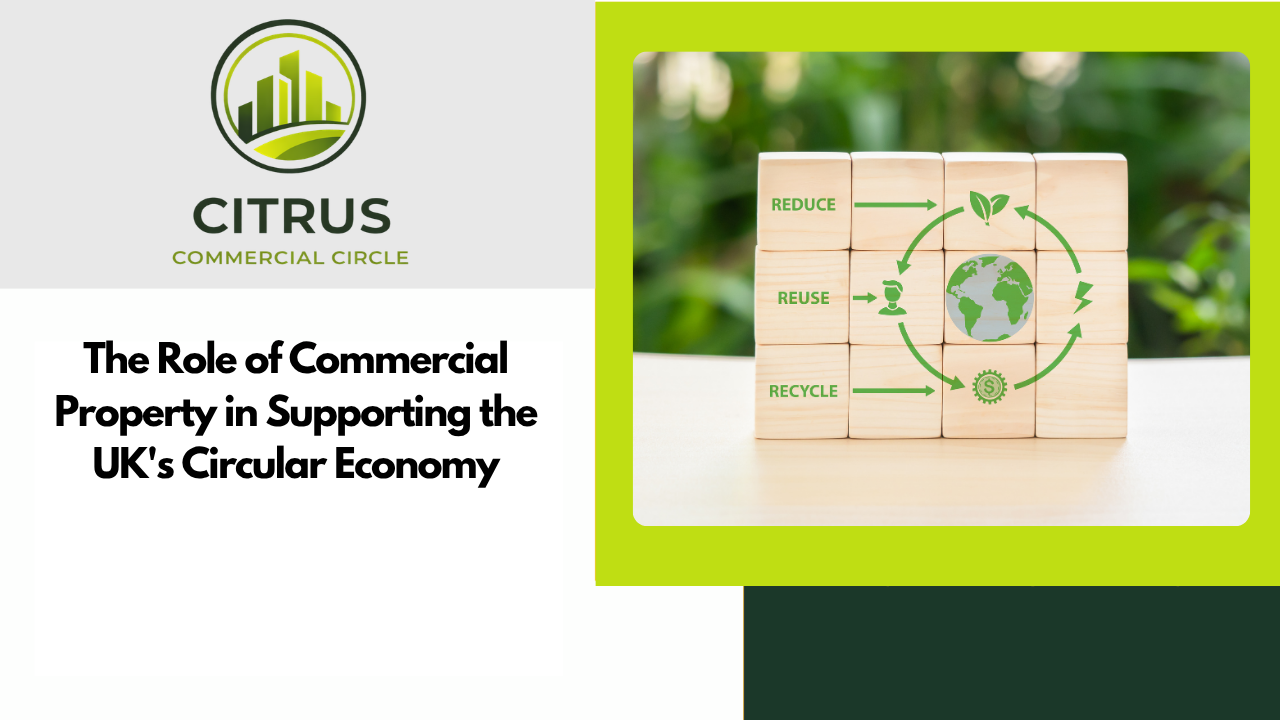
This has led to growing interest in what is known as the circular economy — an economic model focused on reducing waste, extending product lifecycles, reusing materials, and maximising resources.
While discussions around sustainability often focus on products and manufacturing, commercial property plays a critical role in supporting the circular economy.
At Citrus Commercial Circle, we are seeing growing demand from businesses involved in repair, refurbishment, recycling, remanufacturing, and resource recovery. These businesses require commercial premises that allow them to operate efficiently while contributing to a more sustainable economy.
What is the circular economy?
The circular economy aims to keep products, materials, and resources in use for as long as possible.
Rather than following a traditional “take, make, dispose” model, circular businesses focus on:
- Reuse
- Repair
- Refurbishment
- Recycling
- Remanufacturing
- Resource recovery
This approach helps reduce waste while making better use of existing materials and products.
Commercial property provides the operational space needed to support these activities.
Industrial property is central to circular business models
Many circular economy businesses operate from industrial premises.
Examples include:
- Repair workshops
- Refurbishment facilities
- Recycling centres
- Materials recovery operations
- Reconditioning businesses
Without suitable industrial accommodation, these businesses would struggle to process, repair, store, and redistribute products and materials.
Industrial property therefore forms a key part of the circular economy infrastructure.
Repair businesses are growing
Consumers are increasingly choosing to repair products rather than replace them.
Businesses specialising in:
- Electronics repair
- Vehicle repairs
- Equipment servicing
- Furniture restoration
- Machinery maintenance
continue to play an important role within the circular economy.
Companies such as iSmash, The Restart Project, Back Market, and The Bike Project have helped increase awareness around repair and reuse culture.
These activities require practical commercial premises that support workshop operations and storage.
Refurbishment businesses need space to operate
Refurbishment has become increasingly important across many sectors.
Products commonly refurbished include:
- Furniture
- Technology
- Machinery
- Vehicles
- Office equipment
Businesses involved in refurbishment often require:
- Workshop facilities
- Storage space
- Distribution capability
- Office accommodation
Flexible commercial units are often ideally suited to these requirements.
Recycling remains an important industry
The recycling sector continues to play a significant role within the UK’s sustainability strategy.
Organisations such as:
operate extensive facilities dedicated to resource recovery and waste management.
Many smaller regional businesses also contribute significantly to recycling activities and require suitable industrial accommodation to do so.
Commercial yards play an important role
The circular economy often depends on outdoor operational space as well as buildings.
Commercial yards are frequently used for:
- Materials storage
- Vehicle storage
- Equipment processing
- Waste segregation
- Container storage
As demand for recycling and refurbishment activities increases, well-located commercial yards are becoming increasingly valuable.
This is one reason why open storage land remains in strong demand.
Storage supports product lifecycles
A key principle of the circular economy is extending the useful life of products.
Storage facilities help businesses:
- Hold reusable materials
- Store refurbished products
- Manage spare parts
- Maintain inventory
Without adequate storage space, many circular economy operations would struggle to function efficiently.
Commercial property provides the infrastructure needed to support these activities.
Manufacturing is becoming more sustainable
Many manufacturers are adopting circular economy principles within production processes.
This may involve:
- Recycled materials
- Product refurbishment
- Component reuse
- Waste reduction initiatives
Businesses such as Interface Flooring, Patagonia, IKEA UK, and Brompton Bicycle have helped promote more sustainable approaches to product lifecycles.
These trends continue influencing commercial property requirements.
Sustainability is influencing occupier decisions
Businesses increasingly consider environmental factors when selecting premises.
Occupiers may prioritise:
- Energy efficiency
- Waste management facilities
- Sustainable locations
- Flexible operational space
Commercial properties that support sustainable business practices are likely to become increasingly attractive in the years ahead.
Investors are recognising emerging opportunities
The growth of the circular economy is creating new opportunities for commercial property investors.
Businesses operating within sectors such as:
- Recycling
- Refurbishment
- Repair
- Resource recovery
require industrial and operational premises that support their activities.
As these sectors continue growing, demand for suitable commercial space is likely to increase.
Investors are beginning to recognise the long-term potential of these occupier groups.
North Manchester remains well positioned
The region’s strong industrial heritage and established commercial estates make it well suited to circular economy businesses.
Bury and North Manchester offer:
- Industrial accommodation
- Commercial yards
- Transport connectivity
- Access to workforce and customers
These factors help support businesses involved in sustainable operations and resource management.
At Citrus Commercial Circle, we continue to see demand from occupiers involved in repair, refurbishment, recycling, and related sectors.
Citrus Commercial Circle’s market insight
At Citrus Commercial Circle, we understand how emerging economic trends influence commercial property demand.
Our experience allows us to:
- Identify suitable industrial opportunities
- Understand evolving occupier requirements
- Support investors seeking future growth sectors
- Advise landlords on market positioning
The circular economy is likely to become an increasingly important influence on commercial property demand over the coming years.
Final thoughts
The circular economy relies heavily on commercial property to support repair, refurbishment, recycling, storage, and sustainable manufacturing activities.
As businesses continue seeking ways to reduce waste and maximise resources, demand for practical industrial and operational space is likely to grow.
Commercial property will continue playing a crucial role in supporting a more sustainable and resource-efficient economy.
At Citrus Commercial Circle, we are proud to help occupiers, landlords, and investors across Bury and North Manchester identify opportunities within this evolving and increasingly important sector.
Based in Bury. Active across North Manchester. Always on your side.
Call us today: 0161 383 1806
Email: info@citruscommercialcircle.co.uk
Visit: citruscommercialcircle.co.uk
Let’s unlock the full potential together.
Citrus Commercial Circle – Where standards meet success.