
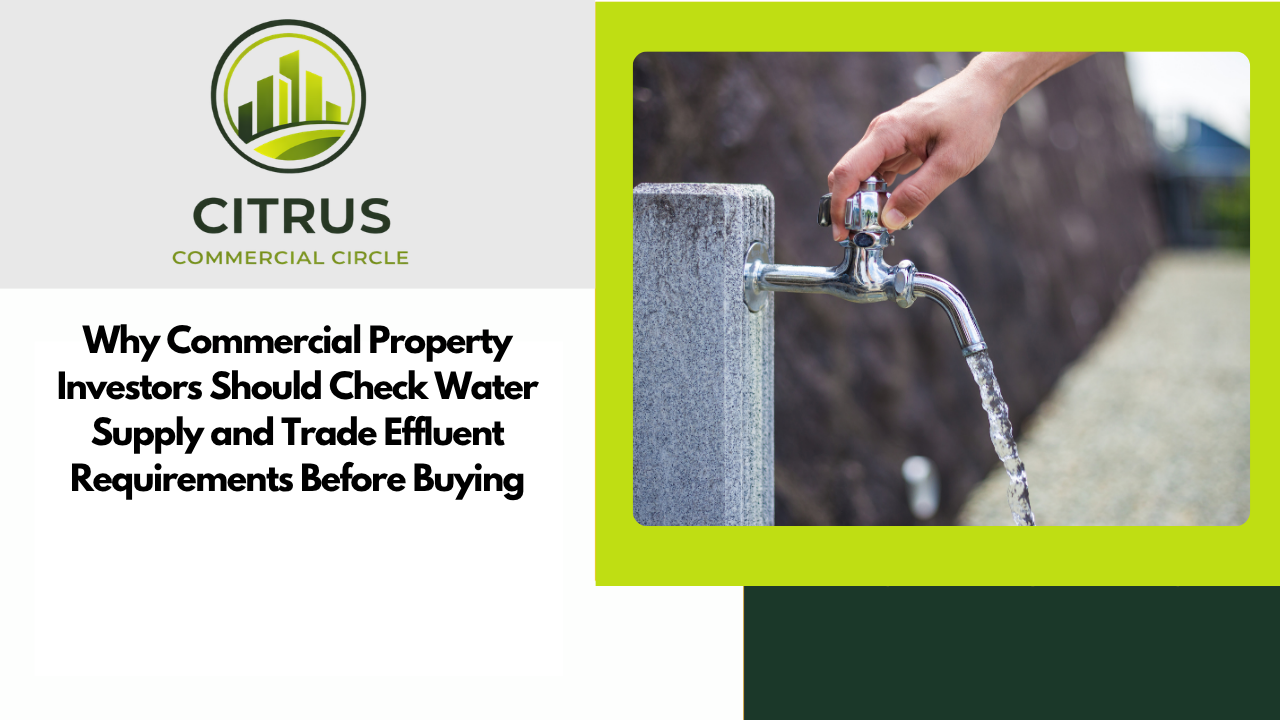
Why Commercial Property Investors Should Check Water Supply and Trade Effluent Requirements Before Buying
An Overlooked Part of Commercial Property Due Diligence
When investors inspect commercial property, they usually focus on the obvious features.
They examine:
- Building condition
- Roof
- Structure
- Electrical supply
- Access
- Parking
- Tenant income
But another important consideration is often overlooked.
Water supply and wastewater disposal.
For some commercial occupiers, these services are relatively straightforward.
An office may only need water for:
- Toilets
- Kitchen facilities
- Cleaning
But other businesses have much more demanding requirements.
Food production, vehicle washing, manufacturing and certain industrial processes can require substantial water supplies or specialist wastewater arrangements.
A building may look suitable for a proposed occupier but lack the infrastructure required to support its operation.
For investors across Bury, North Manchester and Greater Manchester, this makes water and trade effluent an important specialist due-diligence consideration.
Why Water Supply Matters to Commercial Property
Water is often treated as a basic utility.
But the requirements of different businesses can vary significantly.
A small office and a commercial food-processing facility may occupy buildings of similar size while requiring very different water infrastructure.
The investor needs to understand what the building can actually support.
Not Every Commercial Property Has the Same Supply Capacity
A property may have an existing mains connection.
That does not automatically establish that the supply is adequate for every possible occupier.
Relevant considerations can include:
- Connection size
- Available flow
- Water pressure
- Existing internal pipework
- Simultaneous demand
The correct assessment may require specialist advice and information from the relevant water provider.
A Working Tap Does Not Prove Industrial Suitability
During a viewing, somebody may turn on a tap and confirm that water is available.
That is useful, but it proves very little about the property’s ability to support substantial commercial consumption.
A manufacturing process may require a much higher volume of water than ordinary domestic-style facilities.
Understand the Intended Occupier
Water-related due diligence should begin with the likely use.
For example:
Office Occupier
May require relatively modest supplies for staff facilities.
Vehicle Cleaning Business
May require substantial water consumption and appropriate wastewater arrangements.
Food Manufacturer
May require water for processing, cleaning and hygiene.
Industrial Processor
May require specialist water supply or wastewater management.
The precise requirements depend on the operation.
Water Infrastructure Can Affect Letting Demand
Suppose an investor purchases a commercial unit intending to market it towards food production.
The building has:
- Suitable floor area
- Good loading
- Appropriate access
But the water infrastructure cannot support the proposed process without expensive upgrades.
That can reduce its attractiveness to the intended market.
Investigate Before Buying
The correct time to discover major utility limitations is before completion.
Once the property has been purchased, the investor may have fewer options.
Potential costs could include:
- New connections
- Larger pipework
- Internal distribution upgrades
- Specialist equipment
These should be considered within the investment appraisal.
What Is Trade Effluent?
Trade effluent generally refers to liquid waste discharged into the public sewer from trade or industrial activities, rather than ordinary domestic sewage.
Examples may include wastewater from:
- Manufacturing
- Commercial washing
- Food processing
- Certain industrial cleaning operations
The precise regulatory classification depends on the activity.
Trade Effluent Is Not the Same as Ordinary Wastewater
An office toilet produces ordinary domestic sewage.
An industrial process may produce wastewater containing:
- Oils
- Chemicals
- Suspended solids
- Other substances
These discharges can require additional controls.
Trade Effluent Consent May Be Required
In England, businesses discharging trade effluent into public sewers generally need the appropriate consent or agreement from the sewerage undertaker.
The relevant provider should be consulted about the proposed activity.
The Water Industry Act 1991 provides an important part of the legal framework.
Do Not Assume the Previous Tenant’s Arrangements Automatically Suit the Next
A building may previously have been occupied by a business generating trade effluent.
That does not mean every future activity will be covered by the same arrangements.
Consent conditions may be specific to:
- The business
- The discharge
- The process
- The premises
Appropriate checks should be made before occupation.
Why Investors Should Investigate Existing Consents
Where a property is already occupied by a business generating trade effluent, due diligence may need to establish:
- Whether the required consent exists.
- Whether the discharge complies with its conditions.
- Whether monitoring or treatment is required.
- Whether outstanding compliance issues exist.
This can help identify operational and investment risks.
Environmental Compliance Can Affect Property Value
An industrial property associated with unresolved wastewater issues may create concerns for:
- Existing tenants
- Future occupiers
- Purchasers
- Lenders
The extent of any impact will depend on the circumstances.
Trade Effluent Charges Can Affect Occupancy Costs
Some businesses may incur charges associated with trade effluent discharge.
These can depend on factors including:
- Volume
- Strength
- Composition
Businesses should obtain accurate information from the relevant provider.
Landlords Should Understand Total Occupational Costs
An occupier comparing two buildings may consider:
- Rent
- Business rates
- Utilities
- Wastewater charges
A building with a lower headline rent may not necessarily be cheaper to operate.
Water Drainage and Trade Effluent Are Different Issues
Commercial properties can have several drainage systems.
These may include:
- Foul drainage
- Surface-water drainage
- Trade-effluent arrangements
They should not automatically be treated as interchangeable.
Surface Water Must Be Managed Properly
Rainwater from roofs and yards may be handled through different drainage infrastructure.
Industrial sites with extensive hardstanding should be assessed for drainage adequacy.
The Environment Agency provides guidance on preventing water pollution.
Vehicle Washing Requires Particular Care
A commercial vehicle-washing operation may produce wastewater containing:
- Detergents
- Oils
- Dirt
- Other contaminants
The appropriate collection, treatment and discharge arrangements need to be established.
A landlord should not assume that a normal yard drain is suitable.
Yard Drains Can Be Misunderstood
An external drain may connect to:
- Surface-water infrastructure
- Foul sewerage
- Other drainage arrangements
The connection needs to be verified before it is used for potentially contaminated wastewater.
Incorrect Discharge Can Create Serious Problems
Inappropriate disposal of commercial wastewater can create:
- Environmental harm
- Regulatory action
- Operational disruption
Businesses should obtain suitable professional advice before commencing activities involving potentially polluting discharges.
Food Businesses May Have Specialist Requirements
Commercial kitchens and food-production facilities may require appropriate grease-management arrangements.
The correct design depends on:
- Processes
- Equipment
- Discharge characteristics
These matters should be investigated before a building is committed to a specialist use.
Industrial Processes Can Be More Complex
Some manufacturing operations generate wastewater that may require:
- Treatment
- Monitoring
- Controlled discharge
The cost of compliance can influence whether the building is commercially suitable.
Water Supply and Wastewater Capacity Must Be Considered Together
An investor may establish that the property can receive enough water.
But where will the resulting wastewater go?
Both sides of the process need assessment.
A strong incoming supply is of limited benefit if suitable lawful discharge arrangements cannot be established.
Existing Infrastructure May Be Inadequate
Older commercial buildings sometimes contain infrastructure installed for previous occupiers.
That may include:
- Small-diameter pipes
- Ageing drainage
- Shared services
- Unclear connections
These are not necessarily defects, but they require investigation where the intended use depends on them.
Shared Water Supplies Can Create Management Issues
Multi-let buildings may have a shared incoming water connection.
The landlord may then need to understand:
- Metering
- Recharging
- Maintenance responsibility
- Leak management
The lease arrangements should reflect the actual system.
Separate Metering Can Improve Transparency
Where practical and appropriate, individual metering can help identify consumption.
This can reduce disputes over how costs are allocated.
Check the Lease
A commercial lease may address:
- Water charges
- Service connections
- Maintenance
- Repair obligations
But the wording needs to be examined.
Do not assume that because a tenant pays the bill, the landlord has no infrastructure responsibilities.
Water Leaks Can Become Expensive
A leak can cause:
- Property damage
- Increased utility costs
- Business interruption
Investors should consider the condition and accessibility of significant water infrastructure.
Stop Valves Should Be Identified
Knowing where supplies can be isolated is useful for both maintenance and emergency management.
In multi-let property, the arrangement may be more complicated.
Drainage Plans Can Be Valuable
Where available, plans may help identify:
- Drain runs
- Connections
- Inspection chambers
However, older plans should not automatically be assumed accurate.
Site investigations may be necessary.
CCTV Drain Surveys Can Help
For properties with suspected drainage issues, specialist contractors may inspect drainage systems using cameras.
This can help identify:
- Damage
- Blockages
- Defective joints
- Unexpected connections
The need for a survey depends on the property and transaction.
Drainage Problems Can Affect Reletting
A warehouse with recurring wastewater problems may be unattractive to certain occupiers.
Even where the building itself is in good condition, infrastructure weaknesses can affect usability.
Investigate Historical Uses
The previous use of a commercial property can provide clues about its infrastructure.
A former:
- Engineering works
- Food-production site
- Vehicle workshop
may warrant more detailed investigation of drainage and wastewater arrangements.
Historical Use Does Not Prove Compliance
A business may have operated from the property for years.
That does not establish that every aspect of its wastewater management was compliant.
Appropriate documentation and investigation remain important.
Environmental Permits May Also Be Relevant
Some industrial activities may require environmental permits in addition to, or instead of, other wastewater arrangements, depending on the activity and discharge route.
GOV.UK provides guidance on environmental permits.
Investors should obtain specialist advice where relevant.
Discharge to a Watercourse Is Different From Discharge to a Sewer
A business discharging wastewater to a public sewer may face different requirements from one discharging to:
- A river
- A stream
- Groundwater
Do not assume one form of permission covers another.
Understand Who Owns the Infrastructure
A commercial property may connect to infrastructure controlled by:
- Water companies
- Sewerage undertakers
- Private landowners
- Estate owners
Ownership and maintenance responsibilities should be investigated.
Easements May Be Relevant
Where pipes or drains cross neighbouring land, rights may need to be established.
This can become particularly important when:
- Redeveloping
- Extending
- Reconfiguring
a site.
Check Title Documentation
HM Land Registry provides official information relating to registered land.
Solicitors can investigate relevant rights and restrictions.
Development Can Affect Existing Services
An investor proposing a new industrial unit within an existing yard may discover that important drainage runs beneath the proposed building.
Relocating them can increase development costs.
Utility Diversions Should Be Included in Appraisals
Potential development costs may include:
- Pipe diversions
- New drainage
- Connection upgrades
- Specialist treatment equipment
These costs can materially affect viability.
Do Not Assume Connection Upgrades Are Immediate
Additional capacity may require:
- Applications
- Surveys
- Engineering work
The relevant provider should confirm requirements and potential timescales.
Programme Risk Matters
A business may be ready to occupy a building but unable to commence operations until suitable services are available.
That can delay rental income.
Water Infrastructure Can Influence Tenant Selection
An investor marketing a unit to a broad range of industrial occupiers should understand whether certain uses would require substantial infrastructure upgrades.
This allows the property to be marketed realistically.
Not Every Unit Needs Specialist Water Infrastructure
It would be uneconomic to upgrade every warehouse for intensive water consumption without demand.
The objective is to understand the likely market.
Match Infrastructure to Occupier Demand
For example, a conventional storage warehouse may not need the same infrastructure as a food-processing facility.
The property specification should reflect realistic demand.
Investors Should Ask Better Questions During Viewings
Instead of asking only:
“Is water connected?”
ask:
- Is the supply separately metered?
- Is there information on capacity?
- Are drainage plans available?
- Has the property supported trade-effluent activities?
- Are there known drainage issues?
These questions can identify where further investigation is needed.
Obtain Information From the Right Parties
Relevant information may come from:
- Landlord
- Tenant
- Water provider
- Sewerage undertaker
- Specialist surveyor
- Environmental consultant
No single party will necessarily hold every answer.
Record Outstanding Questions
A due-diligence schedule can distinguish between:
Confirmed information
and
Information still requiring investigation.
This helps prevent assumptions becoming accepted as facts.
Existing Tenanted Investments Need Additional Consideration
Where a property is already let, investors should understand the tenant’s operation.
For water-intensive businesses, infrastructure and compliance can be fundamental to continued occupation.
Tenant Business Continuity Matters
A prolonged failure of water supply or wastewater systems could prevent certain occupiers from trading.
This can create income risk for the landlord.
Specialist Occupiers Can Create Concentrated Infrastructure Risk
A building heavily adapted for one industrial process may have limited appeal to alternative occupiers.
Investors should consider what happens if the current tenant leaves.
Reletting Costs Can Be Significant
Specialist equipment or drainage arrangements may need:
- Removal
- Adaptation
- Replacement
before a new occupier can operate.
Consider Reinstatement Obligations
The lease and any alteration licences may address what happens to tenant-installed infrastructure at lease expiry.
These documents should be reviewed.
Do Not Ignore Water Infrastructure During Refurbishment
A landlord may invest in:
- New lighting
- Decoration
- Roller shutters
while overlooking failing drainage.
Cosmetic improvements cannot compensate for fundamental operational problems.
Prioritise Essential Services
Before undertaking major refurbishment, establish whether the building’s basic infrastructure is suitable for the intended market.
Insurance May Also Be Relevant
Water damage can affect buildings and stock.
Investors should understand insurance arrangements and any relevant exclusions or conditions.
Appropriate insurance advice may be needed.
Environmental Risk Is Not Always Visible
A property may look clean and well maintained while containing hidden drainage problems.
This is why technical due diligence can add value.
The Cost of Investigation May Be Small Compared With the Risk
A suitable specialist survey can sometimes identify problems before substantial capital is committed.
The correct investigation should be proportionate to the asset and proposed use.
Include Water and Wastewater in the Acquisition Checklist
For relevant commercial properties, consider:
- Incoming supply
- Capacity
- Metering
- Drainage connections
- Trade-effluent requirements
- Maintenance responsibilities
- Historical issues
Not every item requires an extensive investigation for every property.
The objective is to identify material risks.
Citrus Commercial Circle’s Market Insight
At Citrus Commercial Circle, we believe commercial property investors should understand how a building actually functions.
A warehouse may have:
- Excellent access
- Strong yard space
- Competitive rent
but still be unsuitable for a particular business if its services cannot support the operation.
Water supply and wastewater arrangements are good examples.
They may receive relatively little attention in marketing material, yet they can be fundamental for specialist occupiers.
Final Thoughts
Water and wastewater infrastructure may not be the most exciting part of commercial property investment.
But for certain businesses, they are essential.
Before buying a property intended for manufacturing, food production, vehicle washing or other water-intensive uses, investors should establish whether the necessary infrastructure and permissions can be provided.
That means looking beyond:
“Water connected.”
The more useful questions are:
How much water can the property supply?
What happens to the wastewater?
Are the necessary permissions and systems in place?
Who is responsible for maintaining them?
Answering these questions early can help investors avoid unexpected expenditure, unsuitable acquisitions and operational delays.
Because a commercial building is only valuable to an occupier if it can support the business that needs to operate inside it.
How Citrus Commercial Circle Can Help
Citrus Commercial Circle works with commercial landlords, investors and businesses across Bury, North Manchester and Greater Manchester.
Our team helps clients assess commercial property opportunities, understand occupier requirements and identify premises suited to their investment or operational objectives.
Based in Bury. Active across North Manchester. Always on your side.
Call us today: 0161 383 1806
Email: info@citruscommercialcircle.co.uk
Visit: https://citruscommercialcircle.co.uk
Let’s unlock the full potential together.
Citrus Commercial Circle – Where standards meet success.