
Why Loading Facilities Can Make or Break a Commercial Property
Loading access is no longer just a convenience
For many businesses, the quality of a commercial property isn’t measured by its reception area or office finish—it’s measured by how efficiently goods can move in and out of the building.
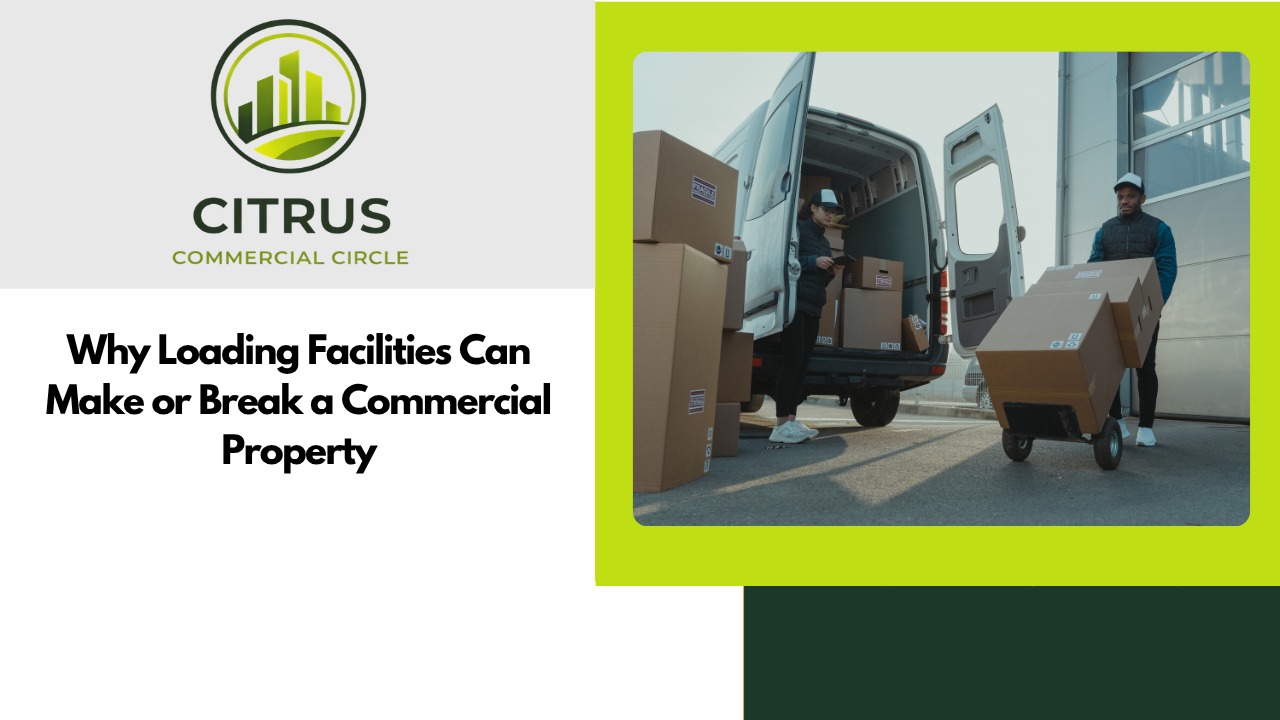
Whether it’s a manufacturer receiving raw materials, a wholesaler dispatching pallets or an online retailer shipping hundreds of parcels each day, loading facilities play a crucial role in day-to-day operations.
A property with poor loading access can create bottlenecks, increase labour costs and slow productivity. Conversely, a well-designed loading area can improve efficiency, reduce vehicle waiting times and support business growth.
At Citrus Commercial Circle, we regularly find that loading arrangements are one of the first features industrial occupiers assess during a viewing.
Why loading access matters
Every commercial operation relies on movement.
Deliveries, collections, courier services and supplier vehicles all require safe and practical access to the building.
Well-designed loading facilities allow businesses to:
- Receive deliveries efficiently
- Dispatch products quickly
- Reduce vehicle congestion
- Improve health and safety
- Minimise disruption to neighbouring occupiers
Even small improvements to loading arrangements can have a noticeable impact on operational performance.
Roller shutter doors remain essential
One of the most desirable features in industrial property is the presence of full-height roller shutter doors.
These provide:
- Faster loading and unloading
- Easier forklift access
- Greater flexibility for larger deliveries
- Improved access for commercial vehicles
Businesses dealing with bulky goods often prioritise properties with multiple roller shutter doors, allowing separate entry and exit points for vehicles.
Yard space adds significant value
Loading isn’t just about the building itself.
External yard space is equally important.
A generous yard allows:
- HGV turning
- Trailer parking
- Vehicle manoeuvring
- Temporary storage
- Safer loading operations
Restricted external space can quickly become a challenge for businesses with regular deliveries.
Dock loading versus ground-level loading
Different businesses require different loading arrangements.
Ground-level loading is often ideal for:
- Builders’ merchants
- Trade counters
- Engineering companies
- Vehicle workshops
Dock loading, meanwhile, is particularly suited to:
- Distribution centres
- Logistics companies
- National retailers
- High-volume warehousing
Understanding an occupier’s operational requirements helps identify the most suitable property.
Courier traffic has increased dramatically
The growth of e-commerce has transformed commercial property requirements.
Daily collections from companies such as DPD UK, Evri, Royal Mail Business and FedEx UK mean that many occupiers now require loading areas capable of handling frequent vehicle movements throughout the day.
Efficient loading arrangements help businesses meet customer expectations for faster deliveries.
Health and safety should never be overlooked
Loading areas should be designed with safety in mind.
Good practice includes:
- Clearly marked pedestrian routes
- Adequate lighting
- Suitable vehicle turning areas
- Good surface condition
- Clear signage
- Sufficient visibility
Reducing the risk of accidents protects employees, visitors and contractors alike.
Parking and loading should work together
One common mistake is assuming that parking and loading can share the same space without issue.
In reality, poorly planned layouts can lead to:
- Blocked access routes
- Delayed deliveries
- Congestion
- Increased risk of vehicle damage
Well-designed commercial estates provide separate areas for loading activities wherever possible.
Investors increasingly consider operational features
Modern occupiers are looking beyond basic specifications.
A property that allows businesses to operate efficiently is often more attractive than one offering only additional office accommodation.
Operational features such as loading access, circulation space and vehicle movement can all contribute to stronger tenant demand.
Future-proofing industrial property
As businesses continue to grow, delivery patterns are changing.
Larger vehicles, increased courier activity and faster distribution networks mean loading facilities are becoming even more important.
Landlords investing in improved loading areas today may enhance the long-term appeal of their commercial assets.
Simple improvements such as widening access roads, improving surfacing or reconfiguring yards can make a meaningful difference.
The North Manchester industrial market
Across Bury and North Manchester, demand for practical industrial accommodation remains strong.
Many occupiers specifically enquire about:
- Roller shutter dimensions
- Yard depth
- HGV access
- Loading arrangements
- Parking availability
- Turning circles
These practical considerations frequently influence leasing decisions more than cosmetic improvements.
At Citrus Commercial Circle, we always encourage businesses to assess how a property will function operationally, not just how it looks during a viewing.
Citrus Commercial Circle’s market insight
At Citrus Commercial Circle, we understand that successful commercial property supports efficient business operations.
By helping occupiers identify buildings with practical loading facilities and advising landlords on improvements that enhance usability, we help create commercial spaces that remain competitive in an evolving market.
Practical design continues to be one of the strongest drivers of long-term occupier demand.
Final thoughts
Loading facilities are one of the most valuable yet often overlooked features of industrial and warehouse property.
Good access, generous yard space and efficient vehicle movement can improve productivity, reduce operating costs and make a property significantly more attractive to prospective occupiers.
As logistics, manufacturing and distribution continue to evolve, buildings designed with practical loading arrangements will remain well positioned for long-term success.
At Citrus Commercial Circle, we are proud to help landlords, occupiers and investors across Bury and North Manchester find commercial properties that deliver operational excellence as well as investment value.
Based in Bury. Active across North Manchester. Always on your side.
Call us today: 0161 383 1806
Email: info@citruscommercialcircle.co.uk
Visit: citruscommercialcircle.co.uk
Let’s unlock the full potential together.
Citrus Commercial Circle – Where standards meet success.