
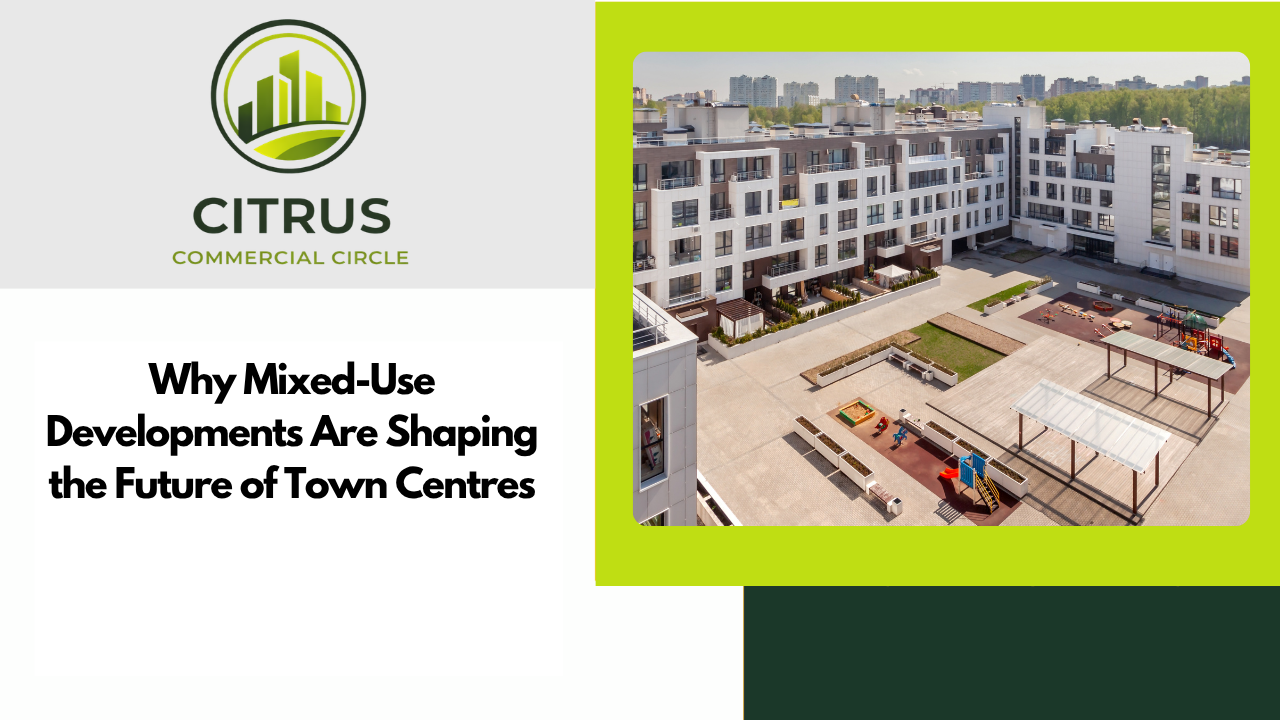
Why Mixed-Use Developments Are Shaping the Future of Town Centres
A new approach to modern commercial environments
Town centres across the UK are evolving. Traditional retail-led high streets are being reshaped by changing consumer habits, flexible working patterns, and the growing demand for more dynamic urban environments.
One of the most significant trends driving this transformation is the rise of mixed-use developments — projects that combine residential, retail, leisure, office, and commercial space within a single location.
At Citrus Commercial Circle, we are seeing increasing interest in mixed-use schemes across Bury, North Manchester, and the wider North West. These developments are becoming an important part of regeneration strategies and are helping redefine how town centres operate.
This blog explores why mixed-use developments are becoming so influential and what they mean for landlords, investors, occupiers, and local communities.
1. What is a mixed-use development?
A mixed-use development combines multiple property uses within one scheme or area.
This may include combinations such as:
- Residential apartments above retail units
- Office space alongside cafés and leisure uses
- Industrial or workspace environments integrated into wider developments
The aim is to create active, sustainable locations where people can live, work, shop, and socialise within the same area.
2. Responding to changing high streets
Traditional high streets have faced increasing pressure in recent years due to:
- Online shopping growth
- Changing consumer behaviour
- Reduced reliance on physical retail
Mixed-use developments help town centres adapt by diversifying how space is used and reducing dependence on retail alone.
This creates more balanced and resilient environments.
3. Increased footfall and activity
One of the biggest advantages of mixed-use developments is their ability to create consistent activity throughout the day.
Residential occupiers, office workers, shoppers, and leisure visitors all contribute to:
- Increased footfall
- Greater economic activity
- Improved support for local businesses
This continuous movement helps town centres feel more vibrant and commercially sustainable.
4. Supporting local businesses
Mixed-use schemes can significantly benefit independent businesses and SMEs.
Increased population density and footfall create opportunities for:
- Cafés and restaurants
- Convenience retail
- Service businesses
- Professional offices
A diverse mix of occupiers helps create stronger local economies and encourages long-term business growth.
5. Making better use of space
Many town centres contain underutilised or outdated buildings.
Mixed-use developments allow developers and investors to:
- Repurpose vacant upper floors
- Convert older office buildings
- Reintroduce activity into underused sites
This helps maximise land use while improving the appearance and functionality of urban areas.
6. Attracting investment and regeneration
Mixed-use developments are often closely linked to wider regeneration projects.
They can help:
- Attract public and private investment
- Improve infrastructure
- Enhance the perception of an area
- Increase property demand and values
As regeneration progresses, surrounding commercial properties may also benefit from rising interest and activity.
7. Greater flexibility and resilience
A key strength of mixed-use developments is flexibility.
By combining multiple uses, these schemes are less reliant on the performance of any single sector.
For example:
- Residential demand may support retail activity
- Office occupiers may generate daytime footfall
- Leisure uses may create evening activity
This diversity creates greater resilience during changing market conditions.
8. Appealing to modern lifestyles
Consumer and business expectations are changing.
People increasingly value:
- Convenience
- Accessibility
- Walkable environments
- Live-work balance
Mixed-use developments align closely with these expectations, creating more integrated and practical urban spaces.
9. Opportunities for landlords and investors
For landlords and investors, mixed-use environments can offer several advantages.
These include:
- Diversified income streams
- Increased tenant demand
- Long-term regeneration potential
- Stronger asset resilience
Understanding how these developments influence surrounding markets is key when assessing investment opportunities.
10. The importance of planning and design
Successful mixed-use schemes require careful planning.
Important considerations include:
- Balance between different uses
- Traffic and accessibility
- Noise and operational compatibility
- Long-term sustainability
Well-designed developments create environments where different occupiers can coexist successfully.
11. Growing demand across the North West
Across Bury and North Manchester, mixed-use developments are becoming increasingly common as local authorities and developers focus on regeneration and town centre revitalisation.
This trend reflects:
- Changing market demand
- Increased focus on urban living
- Greater flexibility within planning policies
The long-term direction of town centres is clearly moving toward more integrated and diverse environments.
12. Citrus Commercial Circle’s perspective
At Citrus Commercial Circle, we recognise the growing importance of mixed-use developments within the commercial property market.
We support clients by:
- Identifying opportunities within regenerating areas
- Advising on commercial positioning and demand
- Understanding occupier requirements across multiple sectors
- Providing practical, locally informed advice
Our knowledge of Bury and North Manchester allows us to help clients adapt to evolving market trends with confidence.
Final thoughts
Mixed-use developments are reshaping town centres by creating more flexible, active, and sustainable environments. By combining residential, retail, office, and leisure uses, these schemes support stronger local economies and more resilient commercial markets.
As towns continue to evolve, mixed-use developments are likely to play an increasingly important role in the future of commercial property.
At Citrus Commercial Circle, we are proud to help landlords, occupiers, and investors across Bury and North Manchester navigate these changing markets and unlock new opportunities for growth.
Based in Bury. Active across North Manchester. Always on your side.
Call us today: 0161 383 1806
Email: info@citruscommercialcircle.co.uk
Visit: citruscommercialcircle.co.uk
Let’s unlock the full potential together.
Citrus Commercial Circle – Where standards meet success.