

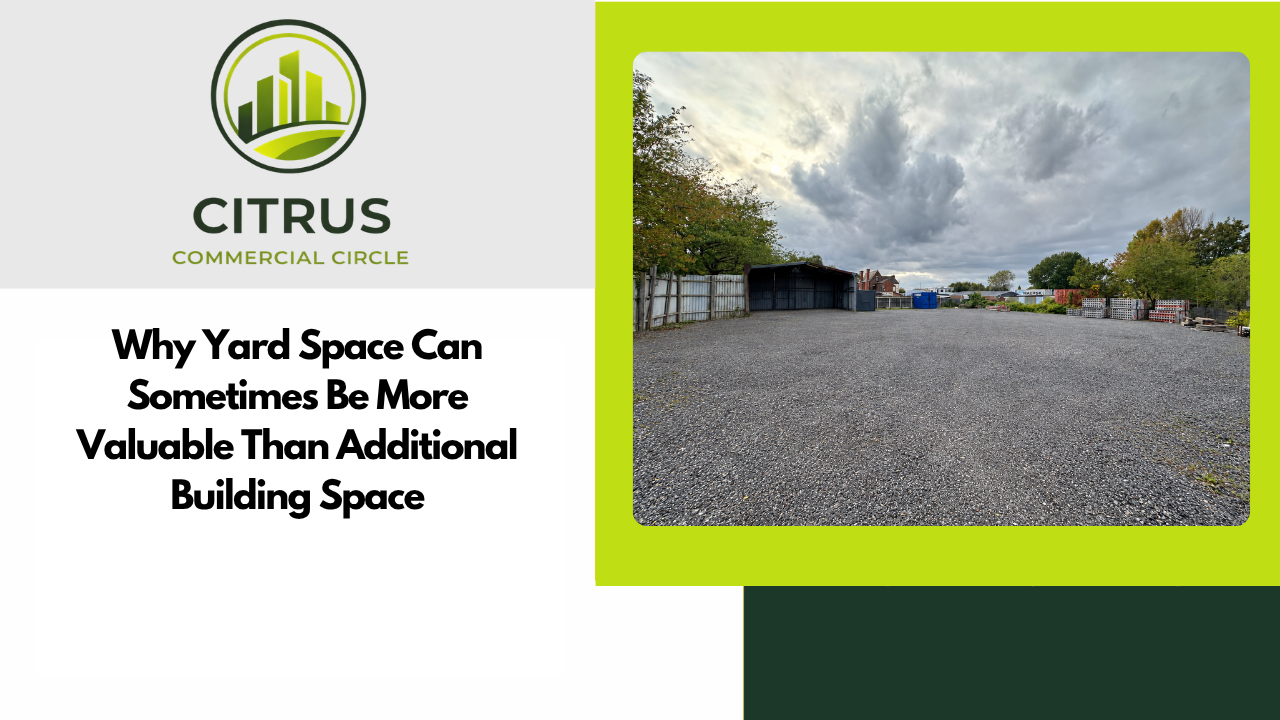
Why Yard Space Can Sometimes Be More Valuable Than Additional Building Space
When commercial property is advertised, one number normally receives most of the attention:
The building’s square footage.
10,000 sq ft warehouse.
20,000 sq ft industrial unit.
30,000 sq ft distribution building.
But for some occupiers, another part of the property can be just as important — and occasionally more valuable:
The yard.
A large warehouse with poor external space can be extremely difficult for certain businesses to operate from.
Meanwhile, a smaller building sitting alongside a secure, well-configured yard may be exactly what the market wants.
For commercial property landlords, developers and investors across Bury, North Manchester and Greater Manchester, this creates an important question:
Should every available part of a commercial site really be built on?
Sometimes the answer is no.
Commercial Property Is More Than the Building
A commercial site should be assessed as a complete operational environment.
That includes:
- Building
- Yard
- Parking
- Loading areas
- Access roads
- Circulation space
- Security
A business does not stop operating when it reaches the roller-shutter door.
For many industrial occupiers, a substantial part of the working day happens outside.
Different Businesses Use Yards Differently
External space can support:
- Vehicle parking
- Loading
- Outdoor storage
- Container storage
- Plant and machinery
- HGV manoeuvring
- Customer collections
The value therefore depends on the occupier.
Contractors Can Be Particularly Yard-Dependent
A contractor may have:
- Vans
- Materials
- Equipment
- Skips
- Plant
A 3,000 sq ft unit with a substantial secure yard might work better than a 6,000 sq ft building with virtually no external space.
Vehicle Businesses Have Different Priorities
A vehicle-related occupier may require space for:
- Stock vehicles
- Customer vehicles
- Vehicle movements
The building may actually be secondary to the external area.
Builders’ Merchants and Trade Businesses Need Circulation
Businesses handling bulky materials need vehicles to:
- Enter
- Load
- Turn
- Leave
A yard filled with parked cars may therefore be far less useful than the same area configured for operational movements.
Yard Space Is Not All Equal
An advert saying:
“Large yard included”
does not tell the whole story.
The yard could be:
- Long and narrow
- Shared
- Poorly surfaced
- Difficult to access
Usability matters.
Shape Can Matter More Than Total Area
Imagine two yards.
Yard A
10,000 sq ft but extremely narrow.
Yard B
8,000 sq ft with a broad rectangular configuration.
For an occupier needing HGV turning, Yard B might be considerably more useful.
Access Is Fundamental
A large yard has limited operational value if vehicles cannot easily reach it.
Consider:
- Gate width
- Road width
- Turning angles
- Obstructions
These details should be assessed during property viewings.
Test the Largest Vehicle
If an occupier expects articulated vehicles, assess the site for articulated vehicles.
Do not test it using a car and assume everything will be fine.
Roller-Shutter Position Can Affect Yard Value
The relationship between:
- Gate
- Yard
- Loading door
can determine how efficiently vehicles move through the site.
Poor positioning can create unnecessary reversing and congestion.
Loading Space Must Remain Available
One common problem is allowing staff or visitor parking to consume the entire yard.
When a delivery arrives, there is nowhere to unload.
Separate Parking From Operational Space Where Possible
Clear zoning can help distinguish:
- Staff parking
- Visitor parking
- Loading
- Storage
This can dramatically improve site efficiency.
External Storage Can Reduce the Need for Building Space
Some goods do not necessarily need to be stored indoors, subject to planning, lease, environmental and operational requirements.
Examples may include certain:
- Building materials
- Plant
- Equipment
If suitable external storage is available, the occupier may require less expensive enclosed floor area.
That Can Change the Property Economics
Suppose a business needs:
- 4,000 sq ft indoor accommodation
- 10,000 sq ft external storage
Offering it a 14,000 sq ft warehouse without a yard does not solve the requirement.
The total area may be identical.
The operational usefulness is not.
Secure Yards Can Command Strong Interest
Security can significantly influence external-space demand.
Features might include:
- Palisade fencing
- V-mesh fencing
- Secure gates
- CCTV
- Lighting
Businesses storing valuable vehicles or equipment need confidence in the site.
Privacy Can Matter Too
A self-contained yard may be more valuable to some businesses than a larger shared estate yard.
Why?
Because the occupier can potentially control:
- Vehicle access
- Storage layout
- Security procedures
more directly.
Shared Yards Can Still Work
Shared space is not inherently bad.
Many multi-let estates operate successfully with communal yards.
But the rights need to be clear.
Ambiguous Yard Rights Create Problems
A tenant may believe:
“That area comes with our unit.”
The neighbouring tenant believes exactly the same thing.
That can quickly create conflict.
Lease Plans Need Accuracy
Where specific external areas are demised or allocated, plans should clearly show them.
This can include:
- Yard
- Parking
- Access routes
Appropriate legal documentation matters.
Access Rights Can Be More Important Than Ownership
A business may not need exclusive control of every road.
But it does need reliable rights to reach its premises.
Title and lease documentation should therefore be reviewed appropriately.
Development Can Accidentally Destroy Yard Value
This is where investors need to be careful.
A large commercial site may appear to contain obvious development land.
The first instinct can be:
“We can build another unit there.”
Perhaps.
But what happens to the existing occupier?
Additional Building Area Can Reduce Existing Rental Value
Imagine a 15,000 sq ft warehouse with a generous yard.
The landlord builds another 5,000 sq ft unit within that yard.
The site now contains more building space.
But the original warehouse may have lost:
- Loading
- Parking
- Turning
The overall value does not necessarily increase.
Site Coverage Needs Balance
Commercial development is not simply about maximising the percentage of land covered by buildings.
The external space needs to support those buildings.
More Building Is Not Automatically More Income
A development appraisal should consider:
Additional rent from new floor area
against
Any reduction in value or marketability of existing accommodation.
Both sides matter.
HGV Turning Can Consume Significant Space
Large vehicles need room.
A plan that looks spacious on paper may become constrained once realistic turning movements are considered.
Swept-Path Analysis Can Help
For developments involving substantial vehicle movements, transport professionals may model how particular vehicles manoeuvre through the site.
This can help test:
- Junctions
- Gates
- Turning areas
before construction.
Do Not Design Industrial Estates Around Cars Alone
A site may appear to have excellent access when viewed from a car.
That says little about how:
- Delivery vans
- HGVs
- Plant transporters
will use it.
Design around the expected occupier.
Yard Depth Can Influence Loading
A roller shutter facing a shallow yard can limit how vehicles approach the building.
A deeper yard may allow more flexible loading.
Multiple Loading Doors Need Space to Function
There is little benefit installing three loading doors if vehicles using one prevent access to the others.
External configuration needs to support the building specification.
Parking Ratios Need Commercial Thinking
More parking is not always better.
A warehouse requiring 100 staff spaces has different needs from a low-employment storage operation.
The right parking provision depends on the likely occupier.
Staff Parking Should Not Damage Logistics
If employees occupy every external space by 8 AM, delivery operations may struggle for the rest of the day.
Visitors Need Safe Areas Too
Trade and customer-facing occupiers may require clearly identifiable visitor spaces.
Mixing customer cars with HGV manoeuvring is rarely ideal.
Yards Can Support Future Business Growth
A business may initially use spare external space for parking.
Later it may need:
- Containers
- Additional fleet vehicles
- More storage
A generous yard provides operational flexibility.
That Flexibility Can Encourage Tenant Retention
If the site can accommodate growth, the tenant may remain longer rather than moving elsewhere.
External Space Can Create Separate Income Opportunities
Depending on planning, title, lease arrangements and site configuration, surplus land might potentially support:
- Separate yard letting
- Container storage
- Vehicle storage
But this needs careful assessment.
Do Not Fragment the Site Without Thinking
Creating a separate yard tenancy can generate additional income.
But it may also interfere with:
- Existing access
- Future development
The short-term income needs to be balanced against long-term strategy.
Planning Matters
External storage and certain commercial activities may require planning consideration.
The Planning Portal provides general information about planning and use.
Site-specific professional advice may be required.
Neighbouring Uses Matter
A yard beside residential property may face different practical constraints from one in the middle of an established industrial estate.
Potential issues can include:
- Noise
- Lighting
- Vehicle movements
These need to be considered.
Operating Hours Can Affect Yard Use
A business wanting 24-hour HGV movements may have different requirements from a daytime contractor.
Understand the intended operation.
Surface Condition Can Change Usability
A large yard with severe:
- Potholes
- Drainage problems
- Uneven surfacing
may require substantial investment before it becomes genuinely useful.
Heavy Vehicles Need Suitable Surfaces
A surface adequate for cars may not perform well under repeated heavy vehicle movements.
Appropriate technical advice may be needed.
Drainage Matters
Large areas of hardstanding need effective drainage.
Standing water can:
- Damage surfaces
- Disrupt operations
- Create maintenance problems
Investigate drainage when acquiring or redeveloping commercial sites.
Flood Risk Should Also Be Considered
Official flood information is available through GOV.UK and the Environment Agency.
For development or acquisition decisions, appropriate professional investigations may be required.
Lighting Extends Yard Usability
Businesses operating:
- Early mornings
- Winter evenings
need appropriate external lighting.
This can improve both:
- Safety
- Security
CCTV Coverage Should Include External Areas
A secure building with an unmonitored yard may not meet the needs of businesses storing valuable vehicles outside.
Gates Need to Work Operationally
A secure gate is useful.
A gate that constantly causes queues or prevents large vehicles entering is not.
Security and accessibility need to work together.
EV Charging Could Increase Competition for Yard Space
Commercial fleets are gradually changing.
Charging infrastructure may occupy areas previously used purely for parking.
Landlords considering upgrades should think about:
- Charger position
- Vehicle dwell time
- Cable routes
without unnecessarily damaging loading operations.
Outdoor Space Can Support Renewable Infrastructure
Depending on the site, external areas may also interact with:
- Battery storage
- Electrical infrastructure
But again, do not sacrifice valuable operational yard without understanding the commercial effect.
Industrial Occupiers Often Think in Site Area, Not Just Floor Area
A business may ask:
“How big is the whole site?”
rather than simply:
“How big is the warehouse?”
That question can reveal how important external operations are.
Marketing Should State Yard Information Clearly
Commercial listings can include:
- Approximate yard size
- Whether self-contained
- Surface type
- Security
where known and appropriate.
Good Photography Should Show the Yard
Do not publish ten photographs of the warehouse interior and one unclear photograph of the entrance if the yard is one of the property’s strongest features.
Aerial Photography Can Help
For larger industrial sites, aerial imagery can demonstrate:
- Site layout
- Yard proportions
- Access
particularly well.
Plans Can Make External Space Easier to Understand
A clear site plan can show how the building and yard relate.
This can improve enquiry quality.
Investors Should Inspect Yards During Working Hours
An empty Sunday site may look spacious.
At 11 AM on Tuesday it may contain:
- Delivery vehicles
- Staff cars
- Pallets
The real operational picture can be very different.
Observe Vehicle Movements
Ask:
- Where do vehicles queue?
- Where do they reverse?
- Where is stock unloaded?
This can reveal hidden constraints.
Speak to Existing Occupiers
Where appropriate, tenant feedback can identify recurring operational issues.
Perhaps the yard floods.
Perhaps HGVs struggle with one corner.
Physical inspection and occupier knowledge can complement each other.
Yard Space Can Influence Reletting Risk
A building with limited external space may appeal to a narrower range of future tenants.
That matters to investors.
Specialist Buildings Need Specialist External Areas
For example, a vehicle operation may need extensive parking.
A distribution operation may prioritise loading.
The yard should match likely occupier demand.
Smaller Buildings With Strong Yards Can Be Surprisingly Liquid
SMEs often want practical premises.
They may care more about:
- Secure external storage
- Parking
- Access
than impressive offices.
Do Not Over-Develop Good Industrial Sites
Sometimes the strongest value-creation strategy is not to build more.
It may be to improve what already exists.
Yard Improvements Can Create Value
Potential works might include:
- Resurfacing
- Fencing
- Lighting
- Drainage
- Line marking
The right improvements depend on the target market.
Compare Yard Investment With Building Extension
Suppose the same capital could fund either:
Option A: a modest building extension.
Option B: resurfaced secure yard with improved access.
Which produces more value?
The answer depends on occupier demand.
Ask Agents What Applicants Are Requesting
If repeated enquiries say:
“We need more yard,”
that is valuable market evidence.
Development strategy should respond to demand.
Do Not Assume Every Empty Piece of Land Is Surplus
Some land appears unused precisely because it allows:
- Turning
- Fire access
- Circulation
Its value may lie in remaining open.
Fire Access Can Restrict Development
Emergency access routes and other safety requirements need to be considered before developing external areas.
The Health and Safety Executive provides general workplace guidance.
Appropriate fire and building professionals should advise on specific schemes.
Utilities Can Run Beneath Yards
Before building on external areas, investigate whether they contain:
- Drainage
- Electricity
- Water
Diversions can affect development cost.
Easements Can Also Restrict Development
Third parties may have rights over part of the site.
Legal title review is therefore important.
HM Land Registry provides official land-registration information.
Yard Development Should Be Appraised Properly
Compare:
- Construction cost
- Additional rent
- Existing rent impact
- Planning risk
- Infrastructure cost
Do not focus solely on the new building.
Consider the Exit
Future investors may value a well-balanced industrial site more highly than an overdeveloped one.
The quality of income and reletting prospects matter.
Flexibility Can Be More Valuable Than Maximum Density
A site with spare yard may allow future owners to:
- Extend
- Reconfigure
- Re-let differently
That optionality has value.
The Best Use Can Change Over Time
Today’s yard might become tomorrow’s development plot.
But once a building is constructed, reversing that decision is far harder.
Preserve Strategic Space
Landlords do not need to develop every opportunity immediately.
Sometimes maintaining flexibility is the stronger investment decision.
Citrus Commercial Circle’s Market Insight
At Citrus Commercial Circle, we regularly see businesses whose property requirements cannot be understood through internal square footage alone.
For many industrial occupiers, the yard is a critical part of the operation.
It may support:
- Vehicles
- Loading
- Storage
- Growth
That is why landlords and developers should be cautious about assuming that additional building area automatically creates additional value.
Sometimes the external space is exactly what makes the existing building attractive.
Final Thoughts
Commercial property value is not simply a competition to create the maximum possible floor area.
A successful industrial property needs to work as a site.
That means balancing:
- Building
- Yard
- Access
- Parking
- Loading
For certain occupiers, losing 5,000 sq ft of yard to gain 5,000 sq ft of building could make the property less useful rather than more.
The strongest development strategy therefore starts with the occupier.
What does the market need?
How will vehicles use the site?
How much external storage is required?
And does the proposed development improve the property as a whole?
Because sometimes the most valuable square foot on an industrial property is not inside the warehouse at all.
At Citrus Commercial Circle, we help landlords, developers and investors across Bury, North Manchester and Greater Manchester understand commercial property demand and identify opportunities to improve the performance of industrial assets.
Based in Bury. Active across North Manchester. Always on your side.
Call us today: 0161 383 1806
Email: info@citruscommercialcircle.co.uk
Visit: citruscommercialcircle.co.uk
Let’s unlock the full potential together.
Citrus Commercial Circle – Where standards meet success.