
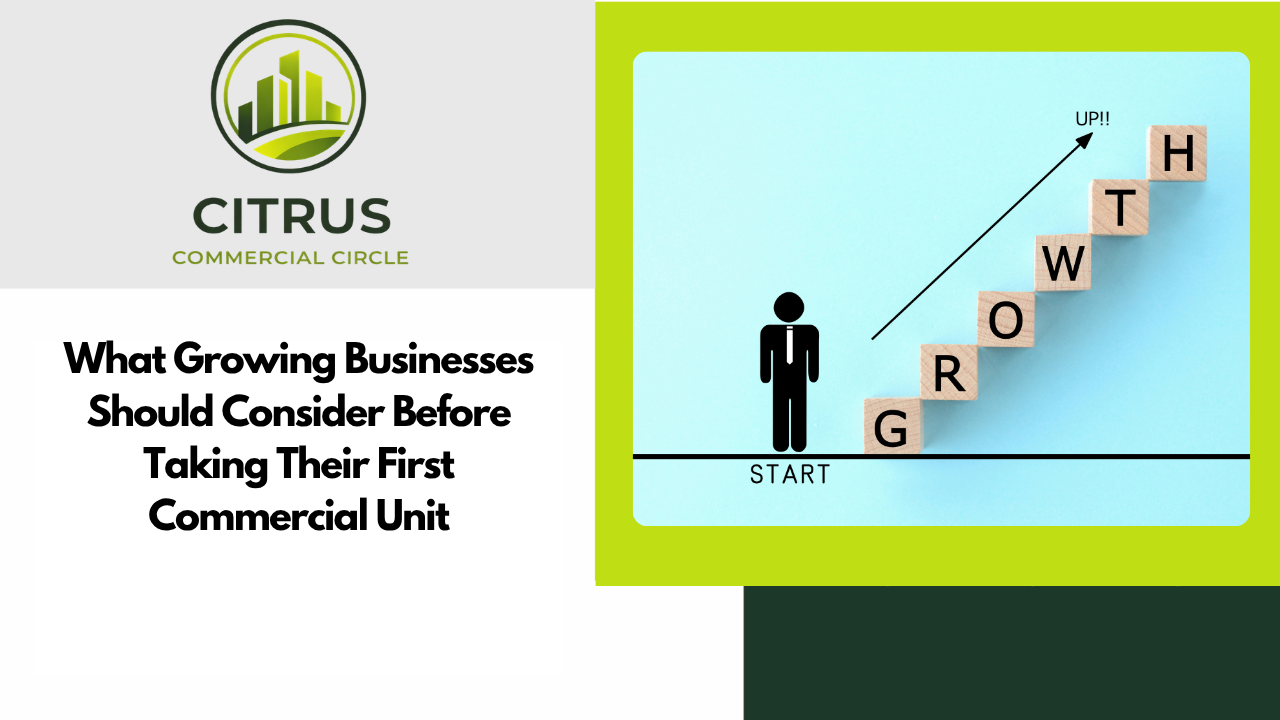
What Growing Businesses Should Consider Before Taking Their First Commercial Unit
Moving into commercial premises is a major milestone
For many businesses, taking a first commercial unit represents a significant step forward. Whether transitioning from a spare bedroom, garage, storage facility, shared workspace, or home office, commercial premises can provide the space and infrastructure needed to support growth.
However, moving into a commercial unit is also a major commitment. Choosing the right property can help a business thrive, while selecting the wrong premises can create unnecessary costs and operational challenges.
At Citrus Commercial Circle, we regularly work with growing businesses across Bury, North Manchester, and the wider North West who are taking their first steps into commercial property. Understanding what to consider before signing a lease is essential.
Understand your actual space requirements
One of the most common mistakes made by growing businesses is either taking too much space or not enough.
Before searching for premises, businesses should assess:
- Current stock levels
- Equipment requirements
- Staffing numbers
- Storage needs
- Customer access requirements
- Future growth plans
A commercial unit should meet current needs while providing some flexibility for expansion.
The goal is to avoid paying for unnecessary space while ensuring the business has room to grow.
Consider how your business operates
Every business uses commercial property differently.
For example:
- Online retailers may prioritise storage and dispatch space
- Tradespeople may require workshop facilities
- Professional services firms may focus on office layouts
- Product-based businesses may need customer collection areas
Businesses using platforms such as Shopify, WooCommerce, BigCommerce, or Squarespace Commerce often require practical fulfilment space rather than traditional retail premises.
Understanding operational requirements should always come before selecting a property.
Location matters more than many businesses realise
The right location can significantly influence business performance.
Factors to consider include:
- Accessibility for staff
- Customer convenience
- Proximity to suppliers
- Delivery routes
- Local business activity
A lower rent may not represent good value if the location creates operational difficulties.
Businesses should focus on locations that support long-term efficiency and growth.
Think about transport and parking
Parking is frequently overlooked during the search process.
Businesses should consider:
- Staff parking requirements
- Customer parking
- Delivery access
- Loading and unloading facilities
For businesses operating vans or service vehicles, adequate access can be just as important as the unit itself.
Poor access arrangements can quickly become operational problems.
Understand the lease agreement
A commercial lease is a legally binding commitment and should be carefully reviewed.
Important areas include:
- Lease length
- Rent review provisions
- Repair obligations
- Break clauses
- Service charges
- Insurance requirements
Many first-time occupiers focus solely on the rent without fully understanding the wider lease obligations.
Obtaining professional advice before signing can help avoid future issues.
Consider future growth
Commercial property decisions should not only focus on current requirements.
Businesses should consider where they expect to be in:
- One year
- Three years
- Five years
Questions to ask include:
- Will additional storage be needed?
- Could staffing levels increase?
- Will more customer space be required?
Flexible premises can help accommodate future growth without requiring an immediate relocation.
Budget beyond the rent
Rent is only one part of the overall occupation cost.
Businesses should also budget for:
- Business rates
- Utilities
- Insurance
- Service charges
- Internet and telecommunications
- Fit-out costs
Understanding total occupancy costs provides a more accurate picture of affordability.
Many growing businesses underestimate these additional expenses.
Connectivity is increasingly important
Reliable connectivity has become essential for most businesses.
Companies increasingly depend on:
- Cloud systems
- Online sales platforms
- Customer relationship software
- Video conferencing
- Inventory management systems
Businesses using services such as Xero, QuickBooks UK, HubSpot, and Mailchimp require reliable internet infrastructure to operate effectively.
Commercial premises should support these operational requirements.
Industrial units are often more versatile than expected
Many growing businesses automatically assume they need office or retail space.
In reality, industrial units can often provide:
- Storage
- Office accommodation
- Dispatch facilities
- Workshop areas
- Customer collection points
This flexibility makes industrial premises particularly attractive to growing businesses.
At Citrus Commercial Circle, we frequently see businesses thrive within practical industrial environments that offer greater operational flexibility.
Security should not be overlooked
Protecting stock, equipment, and business assets is essential.
Businesses should assess:
- CCTV coverage
- Gated access
- Lighting
- Alarm systems
- Estate security
A secure environment can reduce risk and provide peace of mind.
This is particularly important for businesses storing valuable inventory or equipment.
Professional presentation still matters
While practicality is important, presentation remains relevant too.
Customers, suppliers, and staff all form impressions based on the environment in which a business operates.
Well-maintained commercial estates often provide:
- Better first impressions
- Stronger business credibility
- More professional surroundings
Balancing practicality with presentation often delivers the best outcome.
Seek professional advice before committing
Commercial property can be complex, particularly for first-time occupiers.
Professional guidance can help businesses:
- Understand lease obligations
- Assess property suitability
- Negotiate favourable terms
- Avoid common mistakes
Taking advice early can often save considerable time, money, and stress later.
Citrus Commercial Circle’s market insight
At Citrus Commercial Circle, we regularly support businesses taking their first commercial premises across Bury and North Manchester.
Our experience allows us to:
- Understand occupier requirements
- Identify suitable commercial properties
- Explain lease structures
- Support long-term growth plans
We recognise that every business is different and that commercial property decisions should reflect individual operational needs.
Final thoughts
Taking a first commercial unit is an exciting milestone for any growing business.
By carefully considering location, flexibility, costs, future growth, connectivity, and lease commitments, businesses can place themselves in a much stronger position for long-term success.
The right premises should support growth, improve efficiency, and provide a solid platform for future development.
At Citrus Commercial Circle, we are proud to help businesses across Bury and North Manchester find commercial property solutions that support their ambitions and long-term success.
Based in Bury. Active across North Manchester. Always on your side.
Call us today: 0161 383 1806
Email: info@citruscommercialcircle.co.uk
Visit: citruscommercialcircle.co.uk
Let’s unlock the full potential together.
Citrus Commercial Circle – Where standards meet success.