

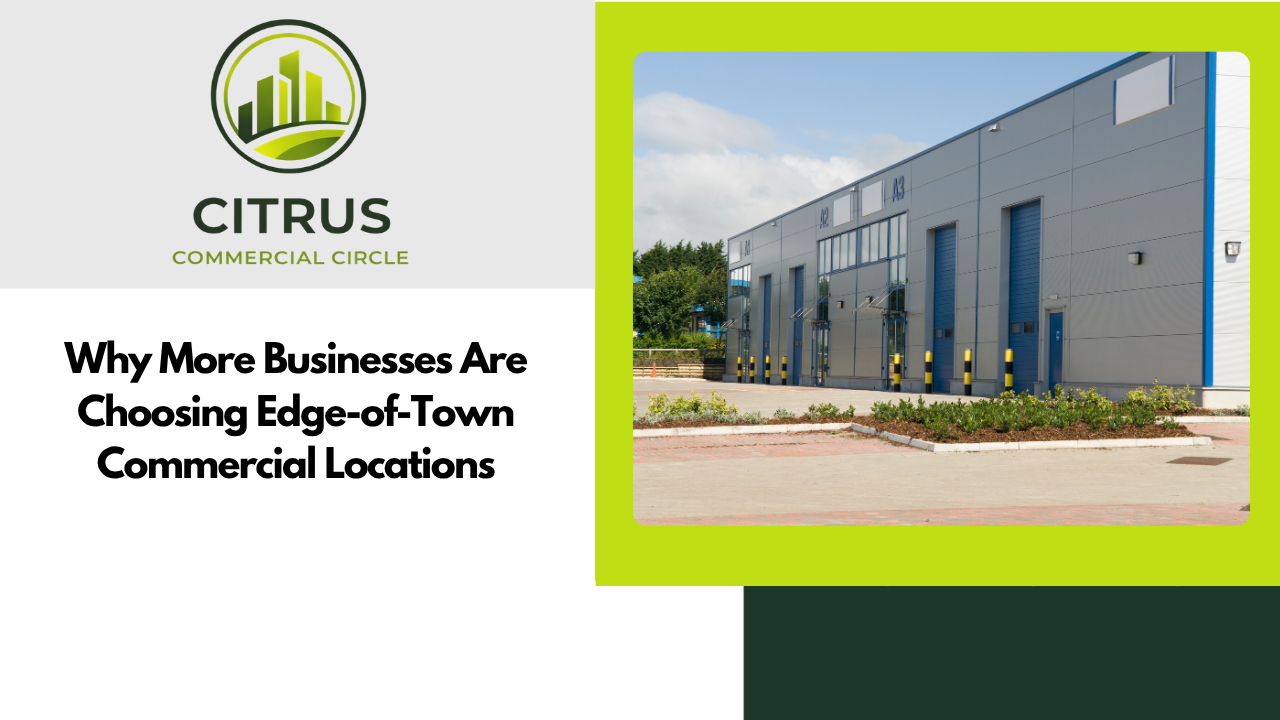
Why More Businesses Are Choosing Edge-of-Town Commercial Locations
Location priorities are changing
For many years, town centres and city centres were viewed as the default choice for commercial occupation. Businesses often prioritised central locations due to footfall, prestige, and perceived convenience.
However, occupier priorities have shifted significantly.
Today, many businesses are actively moving away from busy town-centre locations and instead choosing edge-of-town commercial premises that offer better accessibility, lower costs, and greater operational flexibility.
At Citrus Commercial Circle, we are increasingly seeing occupiers across Bury, North Manchester, and the wider North West favour edge-of-town commercial space over traditional central locations.
This shift is influencing demand across industrial estates, business parks, trade counters, and mixed-use commercial developments.
What is an edge-of-town location?
An edge-of-town commercial location typically refers to premises situated just outside town or city centres, often near major road networks or business parks.
These may include:
- Industrial estates
- Business parks
- Trade counter locations
- Out-of-centre retail parks
- Commercial yards
- Mixed-use developments
These locations often combine accessibility with operational practicality.
For many modern businesses, this balance is highly attractive.
Lower occupational costs attract occupiers
One of the biggest advantages of edge-of-town locations is cost.
Compared with central locations, occupiers often benefit from:
- Lower rent
- Lower service charges
- Lower operating costs
- Better value per square foot
For growing businesses, controlling overheads remains essential.
Many occupiers now prioritise practical value over central prestige.
This shift is driving strong demand for edge-of-town accommodation.
Parking is a major advantage
Parking has become increasingly important for both staff and customers.
Town-centre properties often suffer from:
- Limited parking
- Paid parking
- Congestion
- Restricted loading
Edge-of-town commercial sites frequently offer:
- Dedicated parking
- Free parking
- Better loading access
- Fleet accommodation
This practical advantage is one of the biggest reasons businesses choose these locations.
At Citrus Commercial Circle, parking remains one of the most common occupier requirements.
Road access improves efficiency
Modern businesses increasingly depend on efficient transport connections.
Edge-of-town locations often provide strong access to:
- Motorways
- A-roads
- Regional transport routes
- Distribution corridors
Businesses involved in logistics, trade supply, construction, and services particularly value easy road connectivity.
Reduced congestion can improve:
- Delivery times
- Staff commuting
- Customer convenience
- Operational efficiency
Accessibility remains a major competitive advantage.
Industrial and trade businesses prefer practical space
Certain sectors naturally favour edge-of-town premises.
Examples include:
- Builders merchants
- Vehicle businesses
- Logistics operators
- Contractors
- Manufacturers
- Storage businesses
Companies such as Screwfix, Toolstation, Euro Car Parts, Howdens and Selco Builders Warehouse all benefit from locations that prioritise accessibility and operational practicality over high-street presence.
These occupiers continue driving demand for edge-of-town stock.
Larger space becomes more affordable
Businesses seeking larger premises often find town-centre space financially restrictive.
Edge-of-town locations usually provide access to:
- Larger floorplates
- Warehousing
- Secure yards
- Storage space
- Mixed-use accommodation
This enables businesses to expand without taking on excessive property costs.
Space efficiency has become increasingly important.
Customer behaviour has evolved
Consumer behaviour has changed significantly.
Customers increasingly prioritise convenience over central location.
They often prefer businesses that offer:
- Easy parking
- Quick access
- Convenient collections
- Reduced travel stress
This is particularly relevant for:
- Trade counters
- Showrooms
- Collection points
- Service providers
Businesses that depend on repeat customer visits often benefit from practical locations.
Hybrid working supports decentralisation
Hybrid working has changed commuting patterns.
Many office occupiers now place less emphasis on city-centre locations because staff are commuting fewer days each week.
Instead, businesses increasingly value:
- Convenience
- Parking
- Lower overheads
- Flexible layouts
This has increased the appeal of edge-of-town offices and business parks.
Occupiers now think differently about workplace strategy.
Edge-of-town business parks perform strongly
Business parks located outside busy centres continue performing well.
These sites often offer:
- Professional environments
- Shared infrastructure
- Security
- Parking
- Flexible accommodation
This combination appeals to a wide range of occupiers.
Edge-of-town business parks often provide the best balance between professionalism and practicality.
Logistics and delivery trends reinforce demand
E-commerce and delivery growth continue supporting edge-of-town demand.
Businesses increasingly require premises suited to:
- Fast dispatch
- Vehicle movement
- Stock handling
- Customer collections
Edge-of-town locations often provide superior operational efficiency compared with central locations.
This makes them highly attractive for logistics-focused occupiers.
Investors recognise changing occupier preferences
Commercial property investors are increasingly aware of this shift.
Edge-of-town assets often benefit from:
- Broad occupier appeal
- Strong tenant demand
- Lower vacancy risk
- Long-term relevance
As occupier priorities evolve, investment demand for well-located edge-of-town stock continues strengthening.
Bury and North Manchester are ideal examples
Bury and North Manchester offer excellent examples of why edge-of-town commercial locations perform strongly.
Advantages include:
- Strong motorway access
- Competitive occupational costs
- Established industrial estates
- Large residential catchments
Businesses can access both regional transport networks and local customer bases efficiently.
This combination continues driving occupier demand.
At Citrus Commercial Circle, edge-of-town commercial enquiries remain consistently strong across our portfolio.
Citrus Commercial Circle’s market insight
At Citrus Commercial Circle, we understand how occupier priorities continue evolving.
Our experience allows us to:
- Identify high-demand locations
- Understand changing business needs
- Advise investors on market trends
- Support landlords in maximising asset performance
Edge-of-town locations continue to represent one of the strongest growth areas in commercial property.
Final thoughts
More businesses are choosing edge-of-town commercial locations because they offer affordability, accessibility, flexibility, and operational efficiency.
As occupiers increasingly prioritise convenience over prestige, demand for practical commercial space outside traditional centres continues to grow.
From industrial estates and business parks to trade counters and mixed-use developments, edge-of-town locations are becoming increasingly valuable within the modern commercial property market.
At Citrus Commercial Circle, we are proud to help occupiers, landlords, and investors across Bury and North Manchester identify commercial property opportunities that support long-term growth and business success.
Based in Bury. Active across North Manchester. Always on your side.
Call us today: 0161 383 1806
Email: info@citruscommercialcircle.co.uk
Visit: citruscommercialcircle.co.uk
Let’s unlock the full potential together.
Citrus Commercial Circle – Where standards meet success.